Sixty Yards Ahead
A woman in Philadelphia was arrested for standing in front of a delivery robot. In 1865 the law required a man to walk in front of the machine. Also a six-foot grocery robot that one shopper is sure is following him.

A woman in Philadelphia was arrested for standing still.
Police were called to Filbert Street, next to Reading Terminal Market, where Carolyn Marvin had planted herself in front of an Uber delivery robot and would not move. You know the picture. Beijing, 1989, a man with two shopping bags in front of a column of tanks. This was a robot carrying takeout, and the worst case was somebody's dinner getting cold. The robot waited. Officers asked her to step aside, several times, then charged her with disorderly conduct. Asked if she plans to keep doing it, she said, "I do. Why not?"
It was not her first robot. A witness to an earlier standoff on Broad Street thought the robot had hit her and asked if she was okay. By the witness's account, Marvin said, "No, I have to stop this. They're taking over the world."
She is Dr. Carolyn Marvin, a retired communications professor at Penn, and author of When Old Technologies Were New (1988), the book on how people reacted to the telephone and the electric light when those were the alarming new machines. So one of the leading historians of how people react to new technology is now doing it in person, on Filbert Street, at zero miles an hour. Fieldwork, I assume. She told KYW she plans to keep going, "When I see a robot, and I have enough time, I'll probably do the same thing."
Robots have all the time in the world (or at least until their batteries run out) to outlast us in staredowns. The robots will wait.
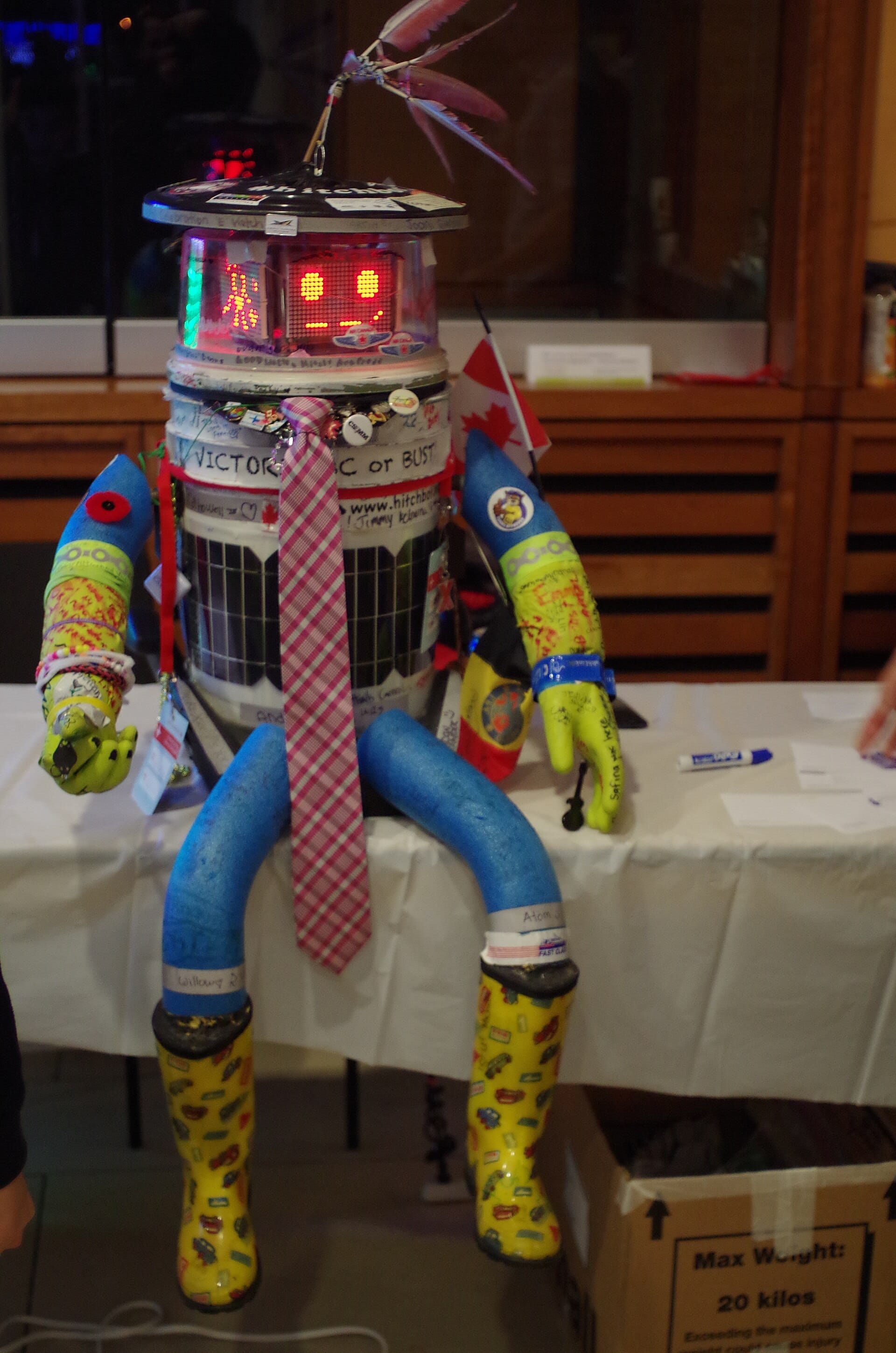
It is not Philadelphia's first robot either. In 2015 a Canadian robot named hitchBOT, which had thumbed rides across Canada, Germany and the Netherlands, set out from Boston to hitchhike to San Francisco. It got as far as Philadelphia, where someone took its head off. Nobody ever found the head.

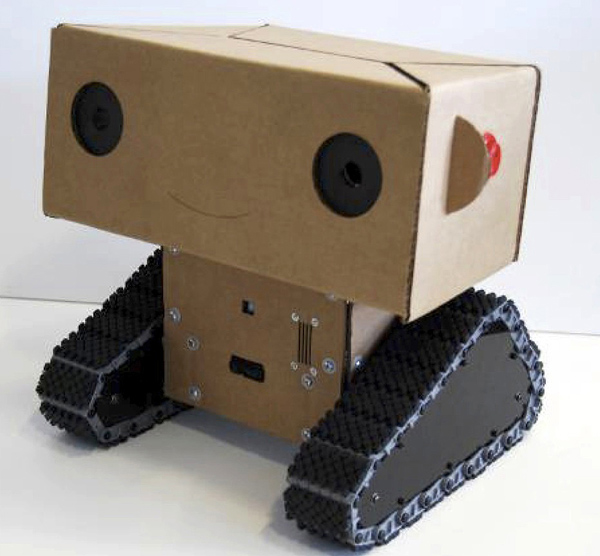
Before hitchBOT there was Boxie. In 2011 Alexander Reben, then at the MIT Media Lab, built a little cardboard robot that rolled around asking strangers for help getting around. People helped. Then they started telling it things, because Boxie also asked questions like "Tell me something that you've never told a stranger before." Robots used to need us.
Now they say hi. In Los Angeles, the robots are following the shoppers. Or one shopper thinks so. At a Ralphs on Pico Boulevard, a six-foot tower of sensors named Tally rolls the aisles, beeping, lights flickering purple and green, with two blinking eyes on a little screen that says "Hi, I'm Tally!" A 62-year-old real estate agent told the Los Angeles Times, "I felt that it was following me." An employee reassured him that it only checks the shelves.
Simbe Robotics, which makes Tally, says the robot "is designed to understand shelf conditions, not identify or track humans," which is exactly what I would say if I was a robot stalking shoppers while "blending in" by weirdly examining the same box of corn flakes for the thousandth time and averting my gaze every time someone noticed me blocking the aisle. A grocery union has a statement titled "Stop the robot invasion in our grocery stores." One Mid-City resident's plan is to start going to Trader Joe's more.
In September more than a dozen Coco delivery robots stalled in a clump on a sidewalk in Chicago's Lincoln Park, edge to edge, as if each one was waiting for another to speak first. The runner who filmed it captioned the video, "Run route was crowded this morning." Coco called it a "sidewalk deployment error," and CBS Chicago called it a Coco cluster. I've had a few sidewalk deployment errors myself (more so now that I have a new puppy in my life).
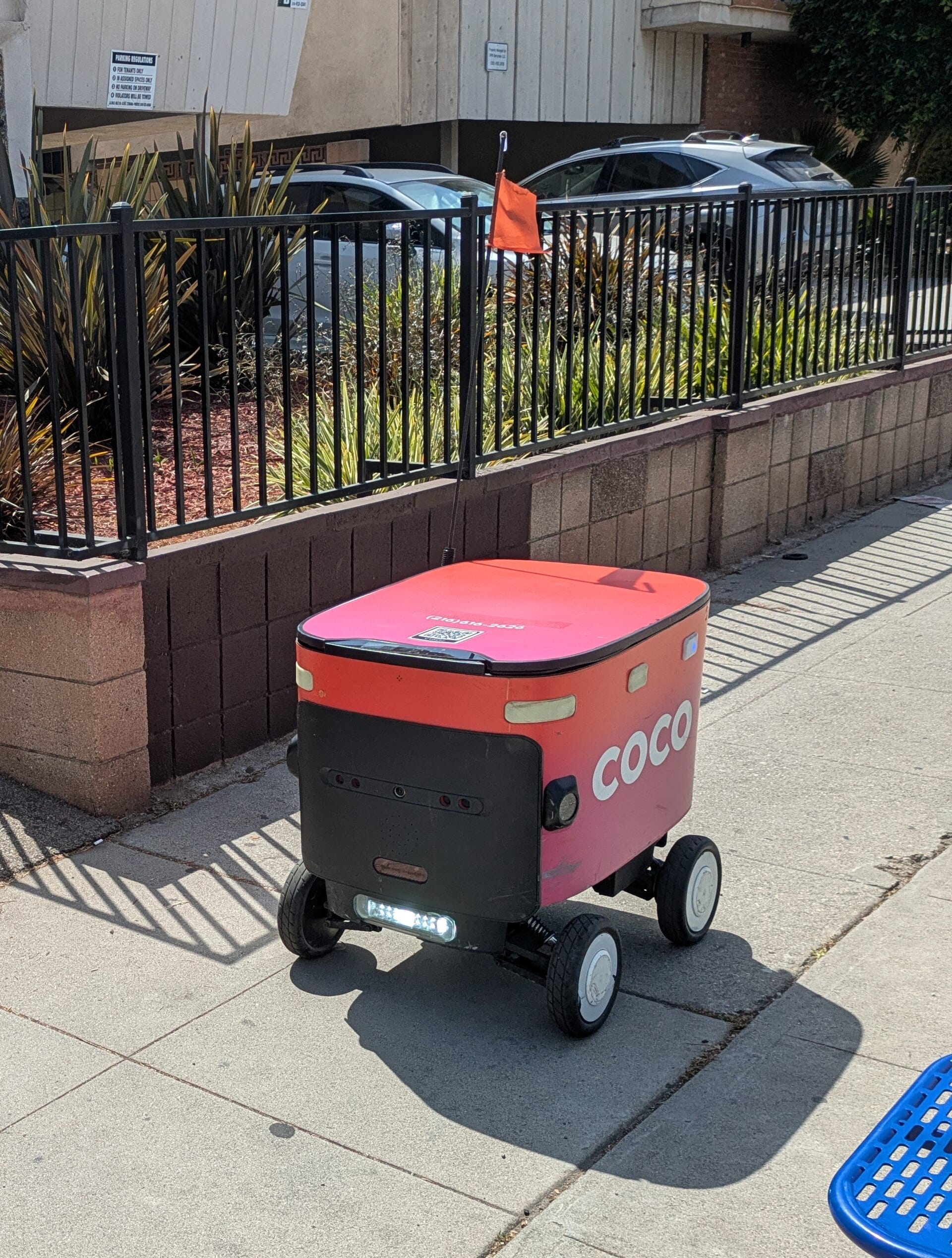

The robot uprising, so far, is six feet tall, says hi, carries somebody's lunch, and gets stuck. (Give it wheels and a passenger and it takes the long way.)
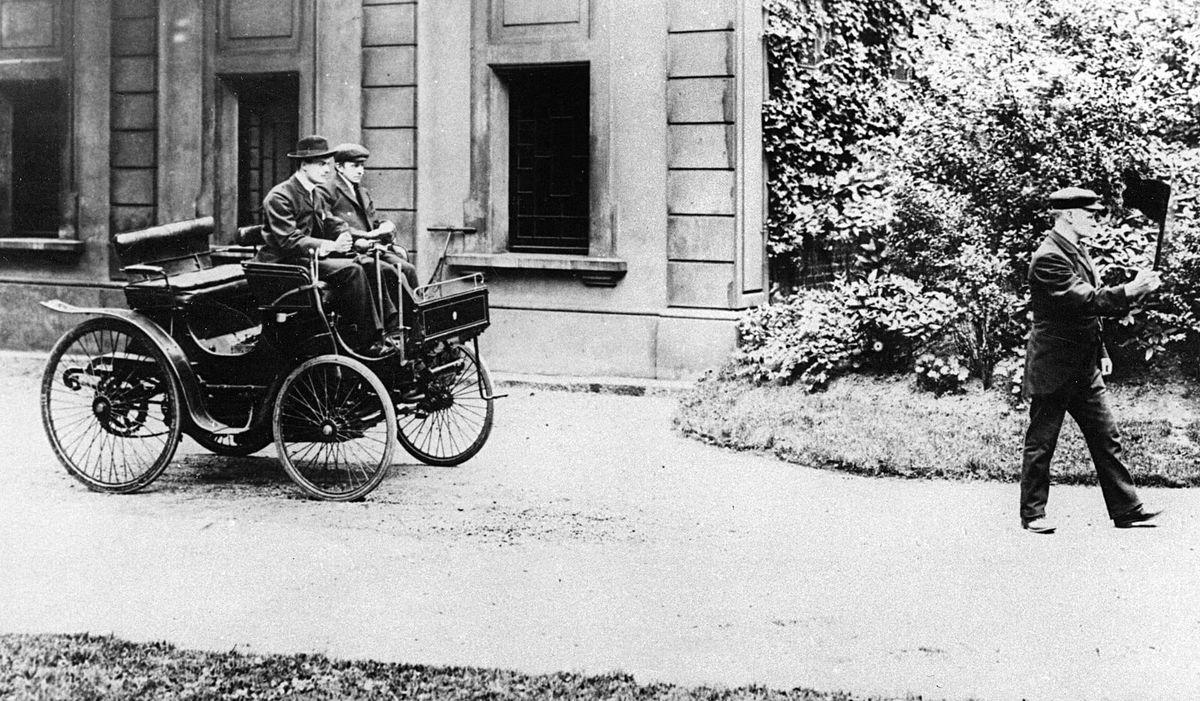
Britain used to require someone to walk in front of the machine. The Locomotives Act of 1865, now known as the Red Flag Act, said that a self-propelled vehicle on a public road needed a crew of three, could go no faster than four miles an hour, and that one of the crew had to walk ahead of it "on foot by not less than sixty yards" carrying a red flag, to warn the horses. In 1896, when a new law dropped the requirement, the drivers celebrated with a run from London to Brighton on a wet Saturday in November. At breakfast, a lord tore a red flag in two. They still do the run every November, flag optional.
For 31 years, then, the law put a human in front of the machine. Carolyn Marvin is 130 years late, and she forgot the flag. In 1865 that was a job. Now it's disorderly conduct.
I am on the robots' side. I studied human-robot interaction and social robotics in grad school, and I've been tracking Pollen Robotics for a while. On Wednesday four of their Microducks, about ten inches tall, were onstage in Berlin with Jensen Huang. They're small, cute and easy to step over (or, in a pinch, kick). A Microduck is not going to block your morning commute, unless you're at a Boston duck crossing or a thousand of them are marching your way. Huang told them to take a nap. One kept walking. Another lagged, tripped, got back up, and Huang said, "Pay attention! Stay focused. Come here, come here. Stay focused." I'm fairly sure the wandering was choreographed. A robot that messes up a little is a robot you want to help. Boxie knew that in 2011.
Earlier in the same keynote, Greenpeace protesters came onstage. Security walked one out. The robot got coaching.
/ David
Listening: "Robots," Flight of the Conchords, 2008. "The humans are dead." In Philadelphia the humans are charged with disorderly conduct, which is less final.
Raising: Kiko, now on Instagram as @kikocavapoo. Small, cute, and not easy to step over.