No Plan Survives the Puppy
A puppy came home a week early, so I built him an app with eight buttons. Also frigatebirds that sleep 40 minutes a day, a collar that can't tell when you pet the dog, and the X-ray AI that is good at saying nothing is wrong.
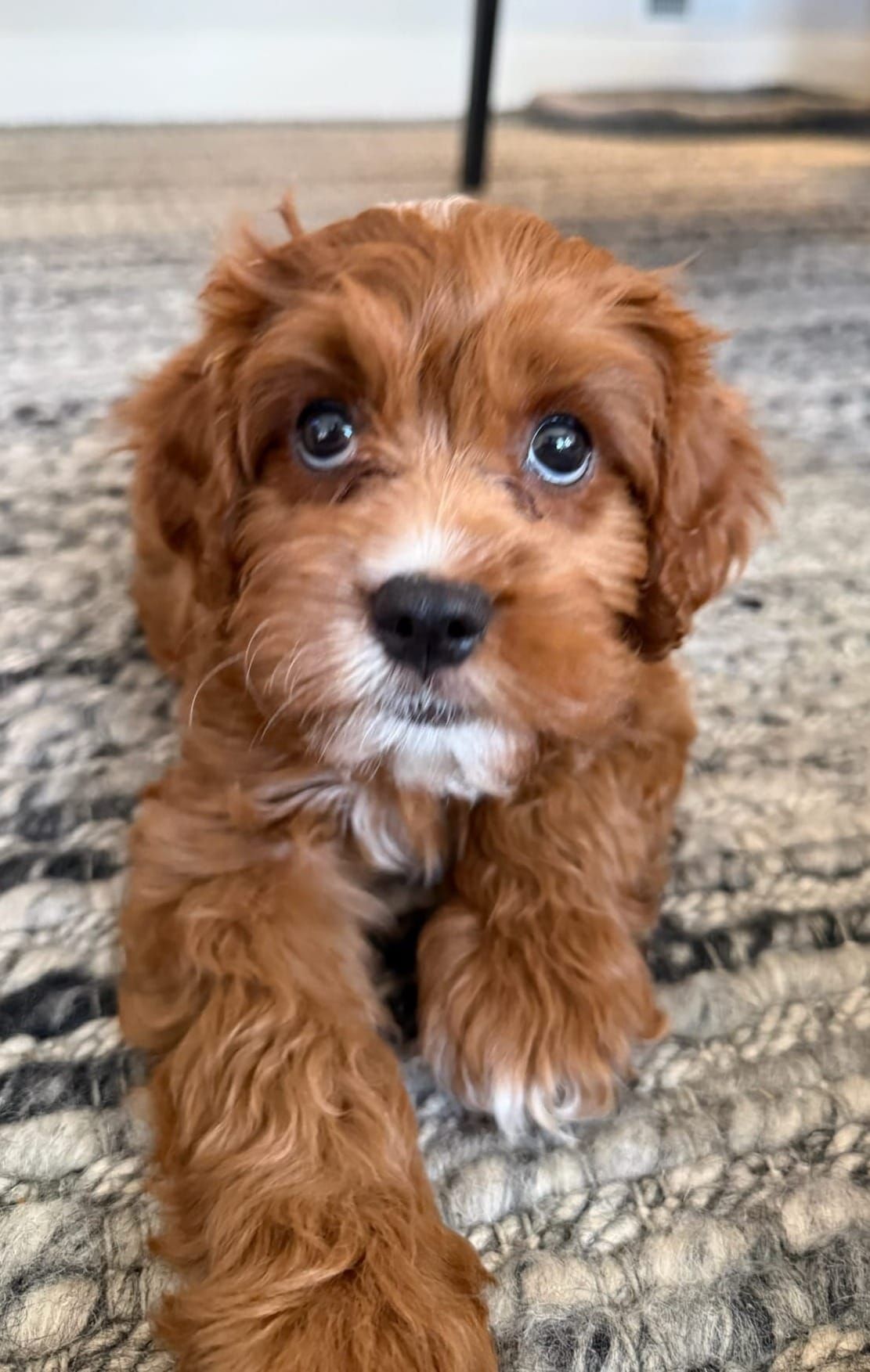
On Sunday we drove to Connecticut before the sunrise and by noon we were back home with an 8.5-week-old cavapoo puppy. His name was Francis for a day (and for years, in my mind). But on Monday he became Kiko. (His naming origin will be a story for another day.)
Last week I mentioned that dogs grew a muscle for puppy dog eyes that wolves don't share. I am now witnessing evidence of this approximately 500,000 times a day.
They say, "No plan survives contact with reality."
This is a tidier platitude than the original by Prussian Field Marshal, Helmuth von Moltke the Elder, in 1871: "No plan of operations extends with any certainty beyond the first contact with the main hostile force."
It was said more bluntly, albeit slightly more viscerally, by one of the greatest heavyweight boxers of all time. Mike Tyson, in 1987: "Everybody has plans until they get hit for the first time." The internet later upgraded it to "punched in the mouth."

I read every plan I could before our puppy's arrival date. Books. Reddit forums, one about Cavapoos and one called Puppy101. YouTube channels like Kikopup and Zak George. It is a lot of information from a lot of different sources, often conflicting. So I used Claude to boil them down to a precise 1-pager schedule and list of poop triggers. Out on waking. Out 15 to 20 minutes after food or water. Out when play slows. Out at least once an hour while he's awake.
Dr. Sophia Yin's "reassurance" stuck with me: any accident is our miss, not his.
Taking responsibility for all puppy mistakes is a lot to live up to, it turns out.
Of course I bought the perfect treats and toys, the perfect harness, the perfect books. We set up the condo with perfect puppy-proof accoutrements. All this so I can demonstrate to my family, friends and neighbors, (and, if we're being honest, perhaps some unexplored corner of my own psyche), that I'm the perfect dog owner.
I knew exactly what to do from the minute he came home and was planning a pleasant, uneventful and fully rested week with the new puppy ahead of me.
Every parent of a new fur baby (or the regular kind) is reading this the way you watch a horror movie when someone says "I'll be right back."
"Plans? Allow me to introduce you to reality."
On the way home, he refused to settle into his perfect travel carrier. He vomited carsickness all over my sleeve. This was not in the plan. But at least I could see he had eaten his kibble for breakfast.
In response to the crate training routine I quite confidently knew would make our little fluffball into the perfectest angel, he has shown his appreciation with stinky piles of poo in the middle of the living room.
The rule of thumb everyone repeats is that a puppy can hold it for about one hour per month of age. Kiko is two months old, so it's easy math! In theory, just take him outside every two hours on the clock and all mischief managed! ✅
In theory.
Kiko's gastrointestinal tract does not run on such a tight schedule. Nor did the schedule account for the distraction of neighbors walking their dogs mid-pee, construction site noise, and cars speeding by. Who could have planned for his unyielding interest and appetite for every leaf and blade of grass surrounding his perfectly designated potty spot?
This dog spent his first weeks on a farm among horses and littermates and now he's in the Big City with garbage trucks, smoke alarms, and two strangers hovering over his every move.
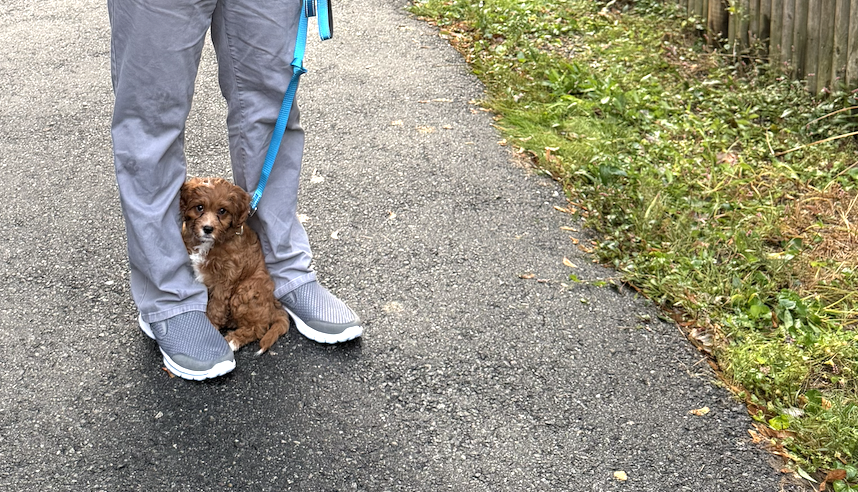
Okay. So admittedly the plans went off the rails once the four little paws intervened. I knew what I needed to do.
Data... for some reason!
I started keeping a log in a note on my phone, in the voice of someone who has been up since 3:30 a.m.:
505 - awoke, immediate pee and poop, came back up and ate a little bit of kibble and drank water... played a bit then went back for a poop around 545. Back up and calmed down for a doze since then
Cue the laughter again from experienced parents recognizing this kind of obsessive note taking is a short-lived exercise in horrific absurdity. Someone already sells a $0.99 app for it.
The notes do not adequately describe the reality: a grown man in the cold night darkness, begging a tiny teddy bear that would better belong on Instagram in a purse or a BabyBjörn to "make tee-tee."
To be fair, we're almost completely accident free now. L and I are spotting the signs he needs to go out (ex. sudden sniffing and circling) and he's picking up the "why am I visiting this same patch of grass for the thousandth time" hint. This, I should point out, has all happened by canine (and sapien) instinct, not a well-formed plan.
It's just "GO POTTY" and "GOOD BOY" with a freeze-dried liver treat as payment for when he deposits his elusive gift in the right spot in the yard.
I'm not claiming any of this is dignified for anyone involved.
As one does in 2026, I built an app.
Monday and Tuesday, mostly while he napped, with AI writing code and me play-acting as a product manager, I built a pup-tracking app for iPhones for just two users.
Pee, Poop, Ate, Drank, Woke, Asleep, Play. One tap each.
It went live on my phone at about 12:40 on Tuesday, and when L played along by pushing a button on her phone, the entry showed up on mine about ten seconds later. We had a shared logging tool. ✅
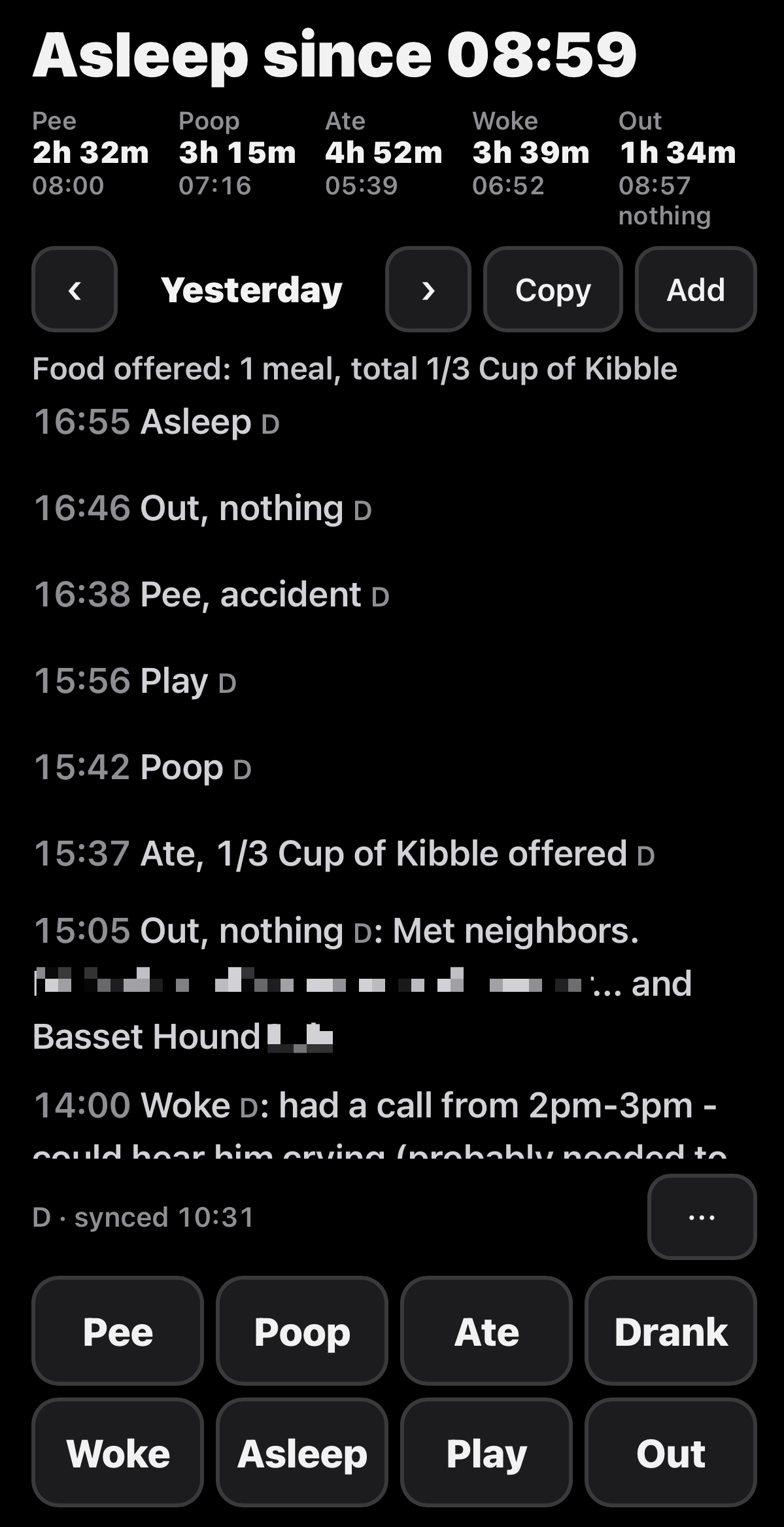
The eighth button, "Out," logs a trip without a pee or poop. The books say take him out when play slows. So you do, and he sniffs around for three minutes and curls up on your feet. Adorable, but technically a "failure" as dictated by the plan, so he goes back inside.
If we just logged "went out" or "peed," as checkbox items, then we'd miss the most common case, we followed the plan, but nothing happened... and he has a bit more bladder control than expected.
This entire process has been a null hypothesis, in a way.
The Poop Generation System
Still, I turned logging from a singular, verbose journaling activity into a button tap that either L or I could easily push.
Never knowing when to leave good enough alone, by Tuesday afternoon I gave the app some additional "helpful" features. Now it shows time since the last pee, the last poop, the last meal, the last wake-up, and a line that reads "Next trip out due by" a time, with the reasoning and a link to start a timer.
By Wednesday morning it had undo history, day navigation, quantities like "Big" vs. "Little" poop, a "5 min ago" button for the tap you forgot to make while holding a squirmy dog, and a button that copies a day as a table for some sort of yet-to-be-determined future analysis. The next milestone is a Patterns view: what the book says, hour by hour, against what Kiko did.
Of course, I'm absolutely feeding this data to an AI so it can poop out some kind of "insight."
Of course I'm going to keep adding more and more to this thing until it has tangled itself into an unwieldy system. It'll probably include custom hardware and vision tracking and built in AI suggestions, for some reason.
I have ambitions for data graphs and prettier user interfaces somewhere down the line. I want more quantified puppy data points, as long as I'm treating my new family member as a science project. Purina publishes a fecal score chart from 1 to 7. Two is ideal. His poops are consistent tootsie rolls, so thank the Heavens I have not found the need to add poop scoring. Yet.
A $0.99 download on app store or, $49.99/month subscription? I'm only half joking.
The nearest thing to it that already exists is Baby Buddy, open-source software parents use to log feedings, naps and diapers. It has an open API, and people have built physical keypads and even a bottle scale on top of it, so a tired parent can log a feed without touching a phone.
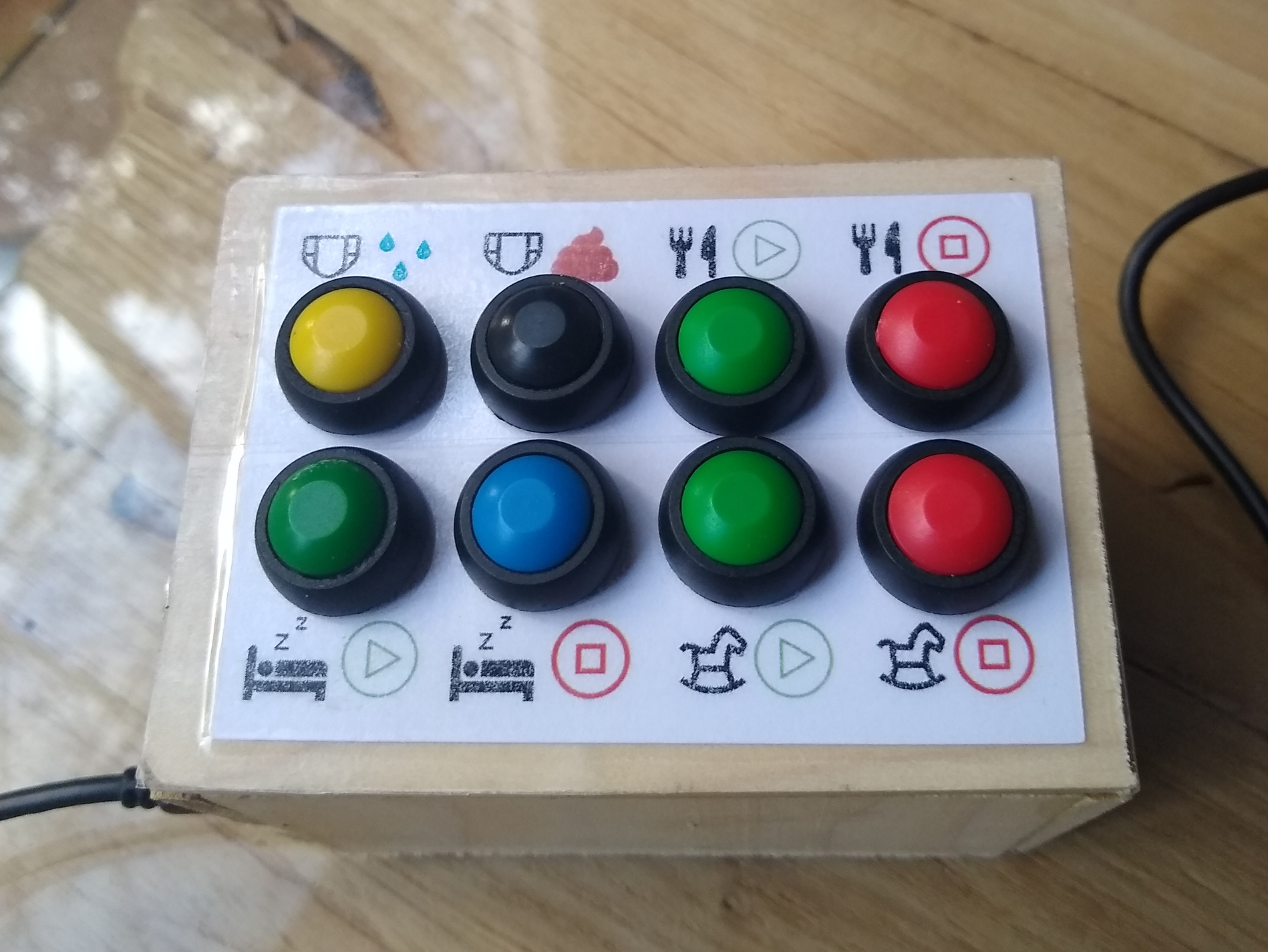
All this Rube Goldberg instrumentation, lovingly assembled around poop-generating machines.
App building as self-soothing.
In January TechCrunch wrote about "micro" apps, software "intended to be used only by the creator (or the creator plus a select few other people)," that "disappear when the need is no longer present." One of the people in the piece took seven days to make a dining app. Mine took two, has two users, and will be finished when the dog is house-trained. Custom software for one specific dog.
I give Kiko chew toys to gnaw on when he's hyped up and needs distraction. He lulls himself into calm through a dedicated focus of effort and productivity that is ultimately futile and pointless. Then the work is abandoned. Then he finally falls asleep, his brain sufficiently mollified.
The metaphor is not lost on me.
The app building gives me a sense of control and purpose where control is impossible to completely achieve nor predict. This probably needs examination at some point because this isn't the first time I've leaned into "building an overwrought system" as my first step.
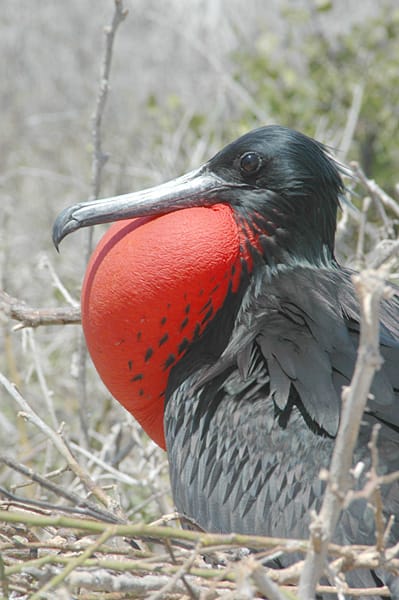
The rest of the animal kingdom is wearing a tracker too. Movebank, where scientists pool animal movement data, holds nearly 12 billion locations across 1,712 kinds of animal as of this week. A tagged bar-tailed godwit flew 8,425 miles from Alaska to Tasmania without stopping, in 11 days and one hour. Frigatebirds wired for EEG over the ocean turned out to sleep about 40 minutes a day while flying, for up to ten days at a stretch, sometimes with half the brain at a time. On land they sleep more than twelve hours.
The instruments keep contradicting the rules of thumb. The American Kennel Club says puppies sleep 18 to 20 hours a day. When researchers asked 2,332 owners, 16-week-old puppies slept about 11 hours. Those are owner estimates, and 16 weeks is older than Kiko, so I'll report back. The same study found that 86.7 percent of dogs with the option chose to sleep near their people. We have drawn a boundary at letting Kiko in our bedroom. Let's see how long that one lasts.
The machines are better at some things than others. A collar accelerometer trained on more than 5,000 videos of 2,500 dogs detects scratching well and licking reasonably well. It barely registers being petted. (The researchers work for the company that makes the collar.)
In one study, shelters found the owners of 72.7 percent of the microchipped strays they took in, and the top reason they couldn't was a phone number in the registry nobody had updated. The tracking worked, but the human's record went stale.
Vets now have AI that reads X-rays. An independent team at Murdoch University tested six commercial services on real X-rays from general practice, each with a confirmed diagnosis, and found that "none appeared suitable for clinical use in their current form," with sensitivity between 28 and 78 percent. (The FDA doesn't require pre-market approval for a device meant for animals.) In a separate study one of the six scored 90.2 percent on overall accuracy against 91.0 for the best of eleven board-certified radiologists, and still caught 68.8 percent of the real abnormalities. Its strengths, the authors wrote, "lie more in confirming normality than detecting abnormalities."
That test only worked because every X-ray in it had a diagnosis a person had confirmed and written down. The models could be graded only because someone kept the record by hand first.
Years ago at the MIT Media Lab, my office mate Dr. Brad Knox had a Boston terrier named Earl. I remember Earl chewing on my shoes, but also tearing around the lab after a laser pointer while a camera tracked his every move. Brad's own research taught computers the way you'd clicker-train a dog, by rewarding the good moves. That idea is cited in the 2017 paper behind RLHF, the technique later used to train chatbots like ChatGPT. Kiko gets freeze-dried liver. The chatbots get a thumbs-up.
That's what my app's eight buttons are: a human-made record of what one dog did, kept by the two people living alongside him. If a camera ever watches his pen and a model tries to tell asleep from awake, the log is the source of truth it gets checked against.
I might even pontificate that the act of logging is the act of noticing. Step counting works the same way. People who wear a pedometer walk about 2,000 more steps a day, and the famous 10,000-step target traces back to a Japanese business slogan. The count doesn't have to be accurate. If watching a number go up gets someone moving, the number did its job. If "successful" poops are approaching 100% then we're winning the puppy-raising game.
Right now Kiko is curled up in a fluffy ball and making those cute sleeping twitches as he's off chasing butterflies bounding on lavender moonbeams and fluffy clouds made of dreams and pup cup treats.
I don't think "06:58 Asleep" is an adequate log entry.
/ David
Listening: Who Let the Dogs Out, Baha Men, 2000. It was me, at ten to five, and nothing happened.
Listening: Kiko and the Lavender Moon, Los Lobos, 1992.
Logging: Pee, poop, kibble, puppy naps. My own sense of reality.