A Perfectly Suitable Desk
“A man of habit, Hemingway does not use the perfectly suitable desk in the other alcove.” (George Plimpton, 1958)

A desk I'm not building yet
I'm redesigning my home office this month. There are thousands of home office and studio walkthroughs on YouTube. I've saved dozens of them as "sources of inspiration" and have been inspired to actually watch a handful. They turned out to be ads for standing desks, or for royalty-free sound effects libraries, for some reason. These videos are helpful in the way that health and wellness videos help you to feel unhealthy and unwell by comparison.
Ernest Hemingway wrote standing up, on an antelope-skin rug, at a typewriter balanced on top of a bookcase in his bedroom. George Plimpton toured the room for The Paris Review in 1958: "A man of habit, Hemingway does not use the perfectly suitable desk in the other alcove." He tracked his daily word count on the side of a cardboard packing case. I track my word count with an app and do nothing with the data.
A standing-desk company that sponsors a good chunk of my queue cites that same interview to sell height-adjustable desks.
Roald Dahl wrote in a garden hut, in his mother's old armchair, with a board covered in green baize across his knees. He'd built the hut to the proportions of Dylan Thomas's writing shed. That's the 1950s version of watching a desk tour, except he then went and built the thing instead of lying in bed scrolling through videos on a phone.
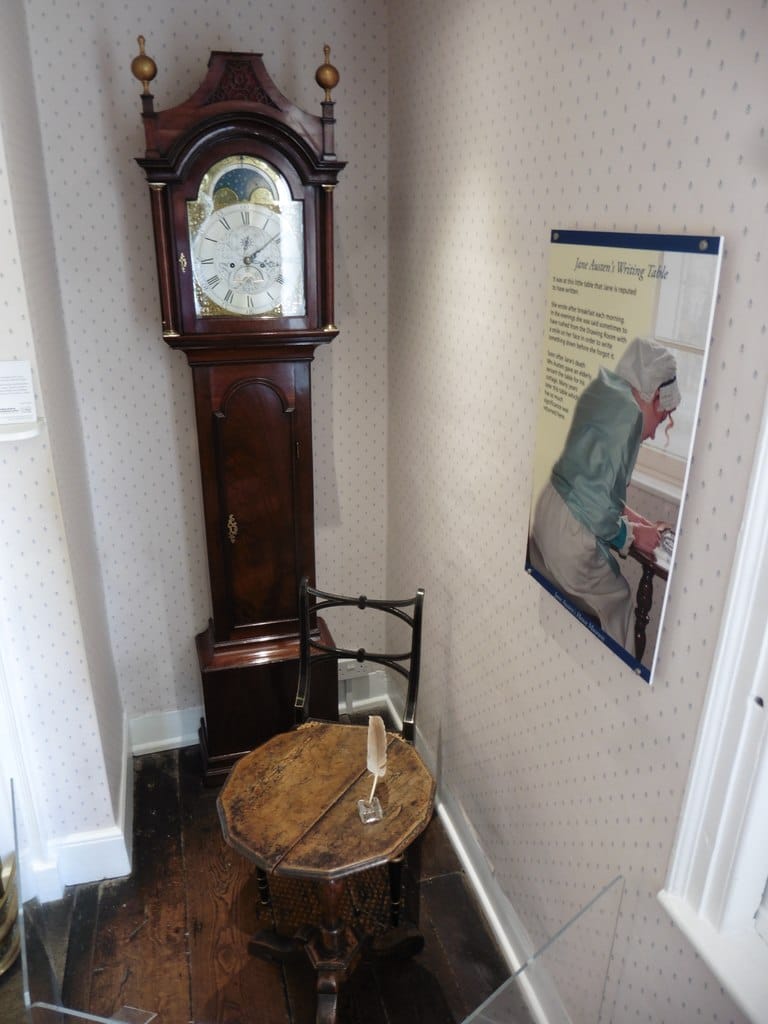
Jane Austen, by family tradition, wrote at a twelve-sided table about the size of a large pizza. It turns out she didn't need a cable management system, or perfectly matched productivity accessories that look pretty on camera and end up as paperweights.
I'll post a before-and-after picture of my home office (or, if we're being fancy, "studio." If we're performing authenticity, "workshop." If we're being insufferable, "atelier.")
Or rather, I'll make a video.

Somebody else's words
They say outsourcing your writing to AI is bad for your brain because you skip the hard work of thinking. Two philosophers, Ten-Herng Lai and Alfred Archer, published a paper in September arguing that letting AI write your apologies, breakup texts and flirty messages skips the part where you figure out what you feel.
Their opening case is a woman who gets a long, thoughtful reply from her boyfriend: "It felt great, until it didn't. Her boyfriend didn't write any of it. ChatGPT did."
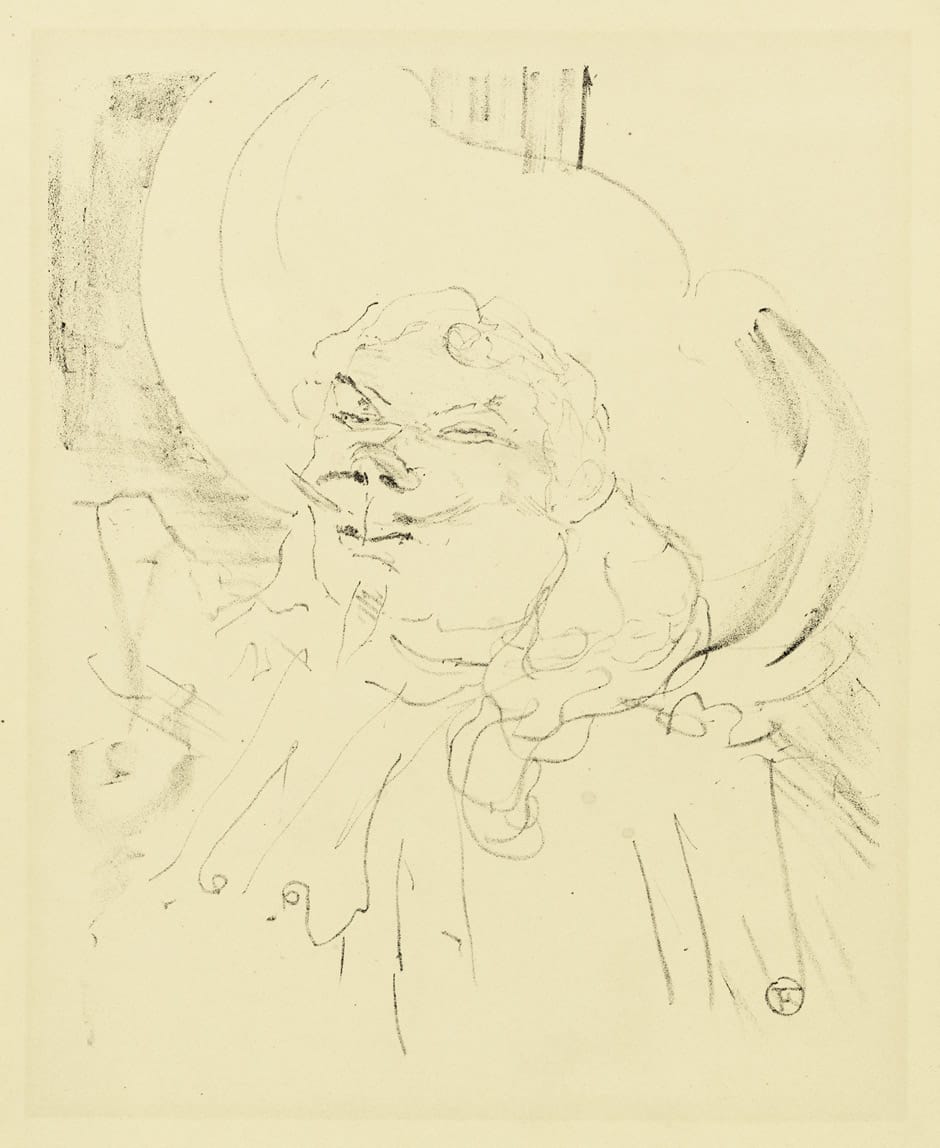
The paper never mentions Cyrano de Bergerac, the long-nosed poet who fed love lines to a better-looking man under a balcony. Somebody should have whispered this in the researchers' ears.
Stanley Milgram, of the electric-shock obedience experiments all the LinkedIn thought leaders cite, leaned into Cyrano. From 1977 until his death in 1984, Milgram ran experiments in which one person spoke words radioed into a hidden earpiece by someone else. He called them "cyranoids." In one version, two boys aged 11 and 12 sat for an interview with a panel of teachers while Milgram fed them the answers. He wanted to see whether the teachers would catch an adult mind behind a child's face. They never pushed hard enough to find out. They asked about fractions and parts of speech, the questions you ask an eleven-year-old. The National Science Foundation turned the grant down twice, and he never published.
In 2015, researchers at the London School of Economics put a chatbot in Milgram's chair. They told 41 people they'd spend ten minutes getting to know another volunteer, and said nothing about AI. Half of them talked to the bot and read its replies on a screen. The other half sat across from a woman who said out loud whatever the bot fed into her earpiece. The researchers called her an "echoborg." Afterward, 14 of the 21 who had the screen suspected they'd been talking to a computer. Of the 20 who faced the echoborg, 3 did. Most of the others decided she was acting a little strange.

A machine in the back room
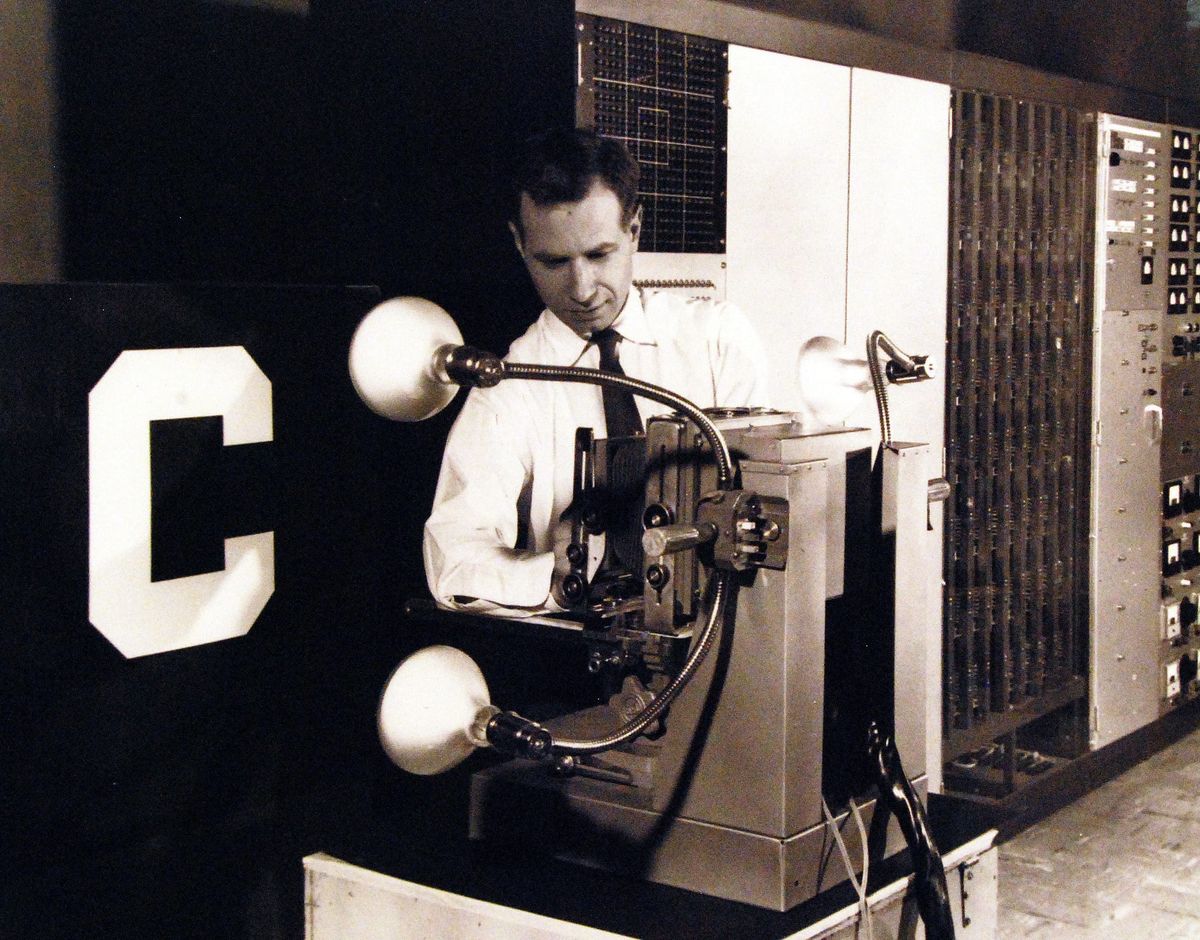
The first neural network is in storage at the Smithsonian. The Mark I Perceptron, built for the Navy at Cornell Aeronautical Laboratory between 1958 and 1960, came to the National Museum of American History in 1967. Its record says "Currently not on display." What survives is two cabinets, together about six and a half feet tall and eleven feet wide: a plugboard, a rack of potentiometers, a panel of meters.
Those potentiometers were the learning. Each weight was a knob, and when the machine got an answer wrong, electric motors turned the knobs. Today's models make the same adjustment to billions of weights on a chip.
In July 1958, the Navy told The New York Times it expected the device to "walk, talk, see, write, reproduce itself and be conscious of its existence." The demonstration that day was a computer learning to tell punch cards marked on the left from cards marked on the right. Eerily familiar overpromising.
Frank Rosenblatt, who built it, also injected brain extract from trained rats into untrained ones, proposed a way to detect planets around other stars, composed music and ran numbers for Eugene McCarthy's 1968 primary campaigns. He died in a boating accident on his 43rd birthday, in 1971. No AI involved in any of those human experiences.
I want to go stand next to that machine. Computation you can walk around, two cabinets of knobs and wires, feels real in a way that's hard to come by when everything else in AI feels artificial and ephemeral.
Talking to the cave wall
PARALLAX posted clips and transcripts from its talks at the end of October. Rus Gant, who spent 12 years at Harvard running its visualization lab (he helped rebuild the Giza pyramids in virtual reality), gave one called "The 39,000 year history of XR." Only about a minute of it is posted. He ended with this: "In the future, we'll end up in our own caves, looking at the cave wall, and discussing with the cave wall what we want to see in our virtual worlds."
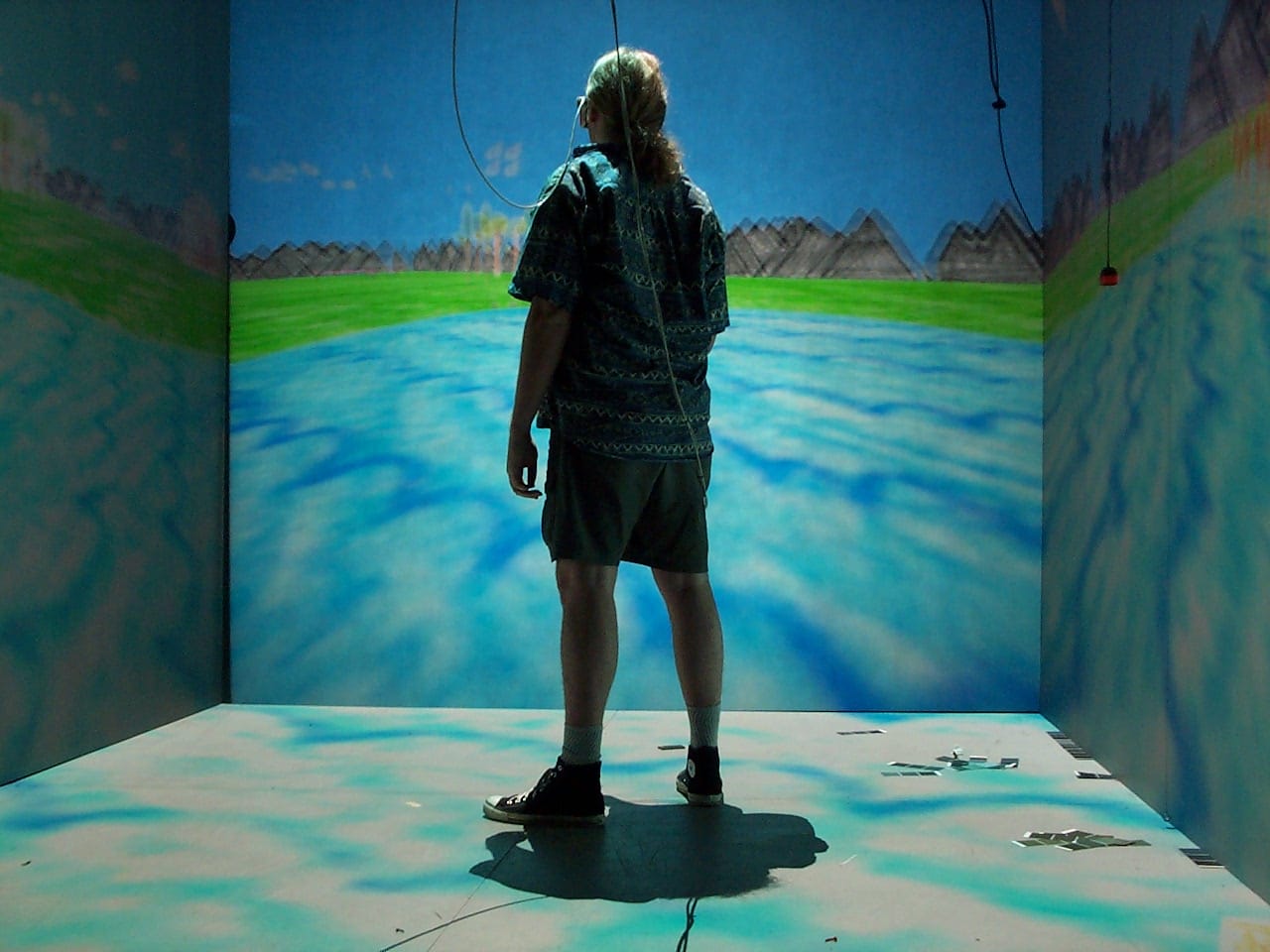
We already built the cave. In 1992, a lab at the University of Illinois Chicago unveiled a room you walk into, with images projected on the walls and floor, and named it the CAVE. Its creators' 1993 paper says the name nods to the allegory of the cave in Plato's Republic. The only new part of Gant's prediction is that the wall talks back.
In September I went inside Newgrange, a Neolithic passage tomb in Ireland built around 3200 BC. Once a year, at the winter solstice, the sunrise comes through a slot above the door and runs down the passage to light the chamber. Tours can't wait for December, so the guides recreate it with an artificial beam of light.
Stonehenge lines up with the solstice sun. At Chichén Itzá, the Maya built a pyramid where the equinox sun casts a serpent of light down the staircase. The sky runs on a clock too long for a person to hold in their head, so people built rooms and stones that fold a year into one beam of light. XR is an attempt at the same thing for whatever we can't see unaided.
If Gant's 39,000 years counts from cave painting, the title is already out of date. In January, Nature published a hand stencil in an Indonesian cave dated to at least 67,800 years ago. The history of XR got 28,000 years longer.

/ David
Listening: "Virtual Insanity," Jamiroquai, 1996. A man stands still while the room moves around him. It's also a fair summary of the office redesign so far.