The Log Is Fake
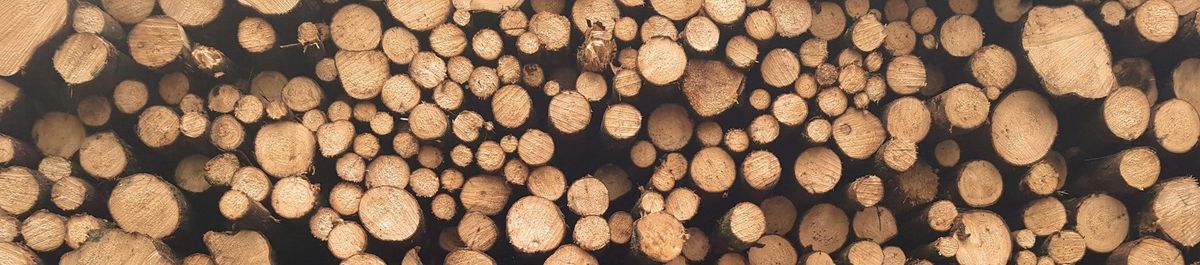
I lost twenty minutes to a website that lets you chop firewood, and it handed me something my work keeps withholding: a finished pile.
I really like doing the dishes.
I get irrationally upset when we have kind-hearted house guests who simply want to do the polite and humane thing by rinsing the dishes after dinner. Fuming in my mind, ruining a perfectly lovely evening, "It's my job. Stay in your lane!"
See, I like that the sink is full and then it isn't. There's the smell of soap, the dishwasher humming, a before and an after, and no follow-up meetings and next actions to track. It's a comprehensively (if not weirdly) satisfying check off my to-do list.

My paid work almost never gives this. I move ideas around inside glowing rectangles all day; the pile never shrinks... There's no "done." It's quite the opposite. Some evenings, I can't tell you what I started, much less finished, and my computer keys never give me the proof-of-work dishpan hands.
Signal: I want finished piles.
So I understood right away why I lost twenty minutes this week to a website that lets you chop firewood. It's called (ahem) "Firewood," and Boing Boing found the right words for it: satisfying, peaceful, cosy.
A round of wood sits on a stump. You "swing an axe" and the wood splits.
No score, no timer, no way to lose.
The artist who made it, Gavin Shapiro, 3D-scanned a real stump and axe and recorded the actual sounds of splitting wood, which is a remarkable amount of labor and craft for a toy whose only promise is that a virtual log will come apart when you tell it to. It inspires emotionally charged discussion about wood-splitting simulators, and it all reminds me of the moment we're in.
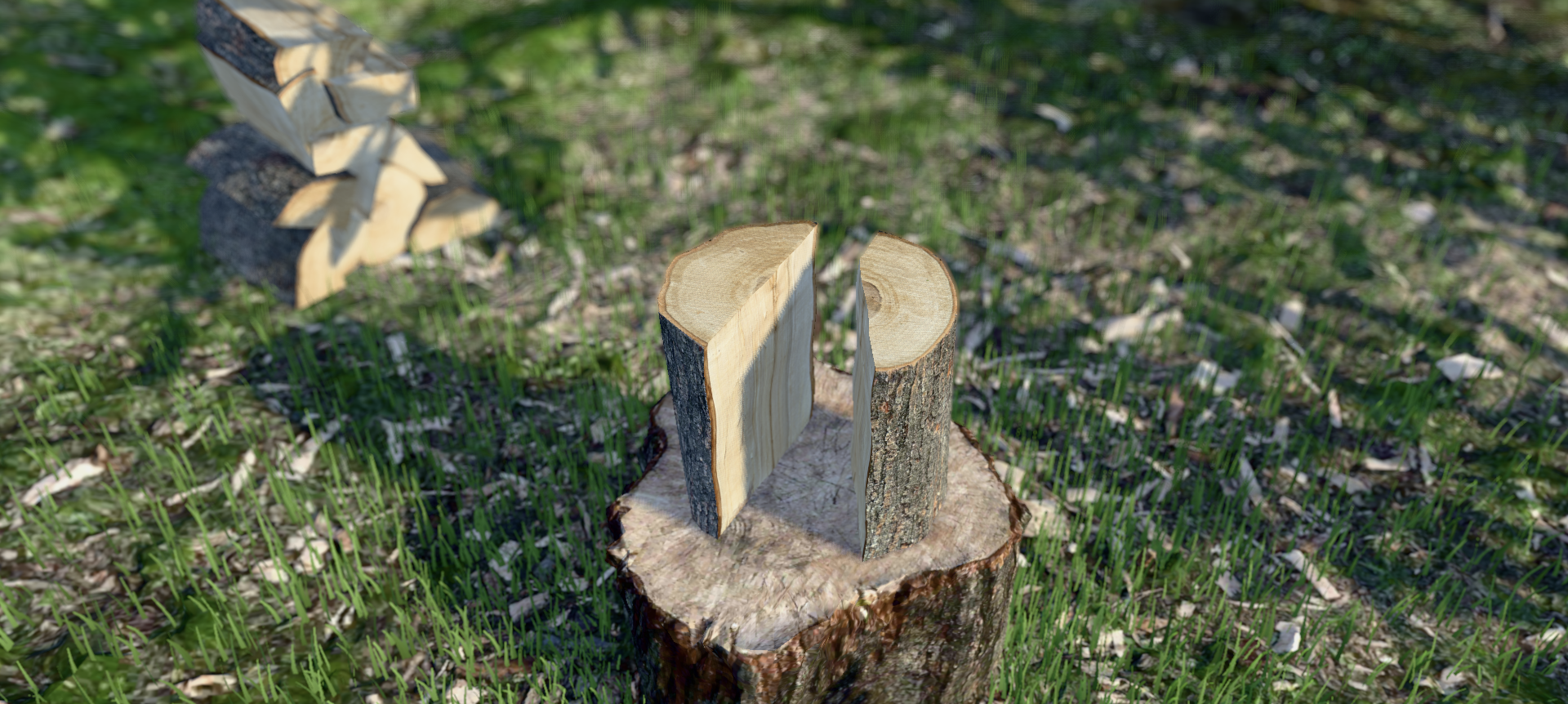
It isn't trying to precisely simulate forestry, wood physics, the smell of pine, or the ache in your shoulders. It strips the work down to a single satisfying verb, "chop."
It gives you a sensory dividend with none of the labor. I felt the little hit anyway. The fake log handed me the exact thing my digital work tends to withhold: a finished, neatly stacked pile.
That's the itch: Closure. A task with edges, a visible dent, and some proof that I was the one who pretended to swing the axe, and that my "effort" made a difference... however fake it was.
Probe: I chopped a cord of wood that doesn't exist.
Turns out I'm late to a very crowded party.
Cleaning a filthy patio until it gleams is now a blockbuster: PowerWash Simulator tells you outright to "wash away your worries," and more than 17 million people have taken the offer. You can run a corner grocery that has pulled more than 50,000 players at once, a roadside gas station, a long-haul trucking route that has sold ~13 million copies, or an entire farm that has sold ~40 million across the series. One game even starts you running a laundromat, emptying lint traps and collecting quarters before you're allowed anything more glamorous, and another turns unpacking your moving boxes into a quiet ritual.
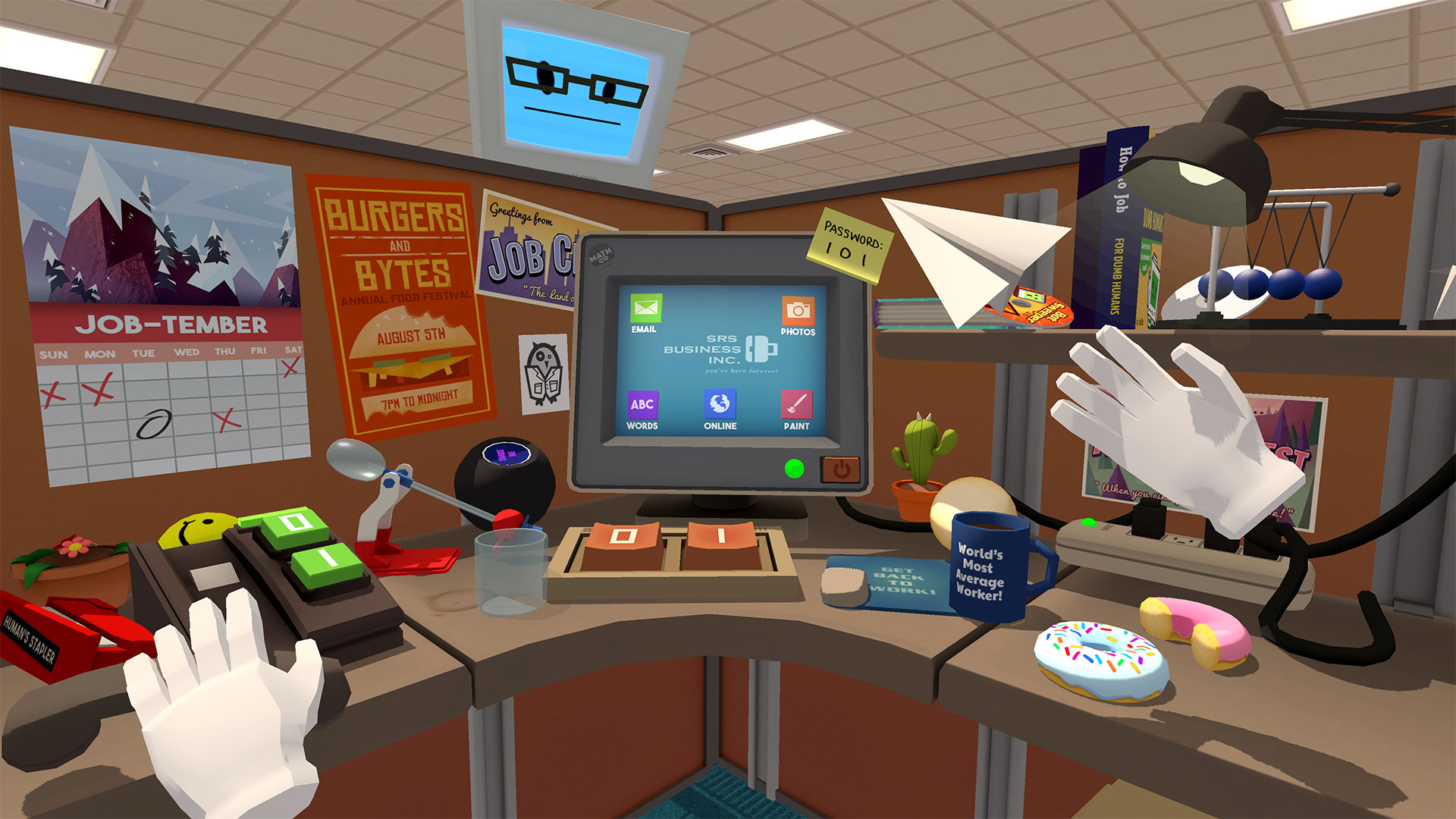
One of the original and most successful of them was made by my friend Alex. Owlchemy Lab's Job Simulator premise is that robots took all the human jobs, so you strap on a headset to play-act at office work. Six million people have installed the joke.
Fruit Ninja, which at its peak sat on a third of all American iPhones, worked because a finger dragged across glass is a legible stand-in for a blade, and the game answered every swipe with juice: the arc, the splash. Better touchscreens let the phone answer your finger with a small haptic tap, so the fake cut even felt confirmed.
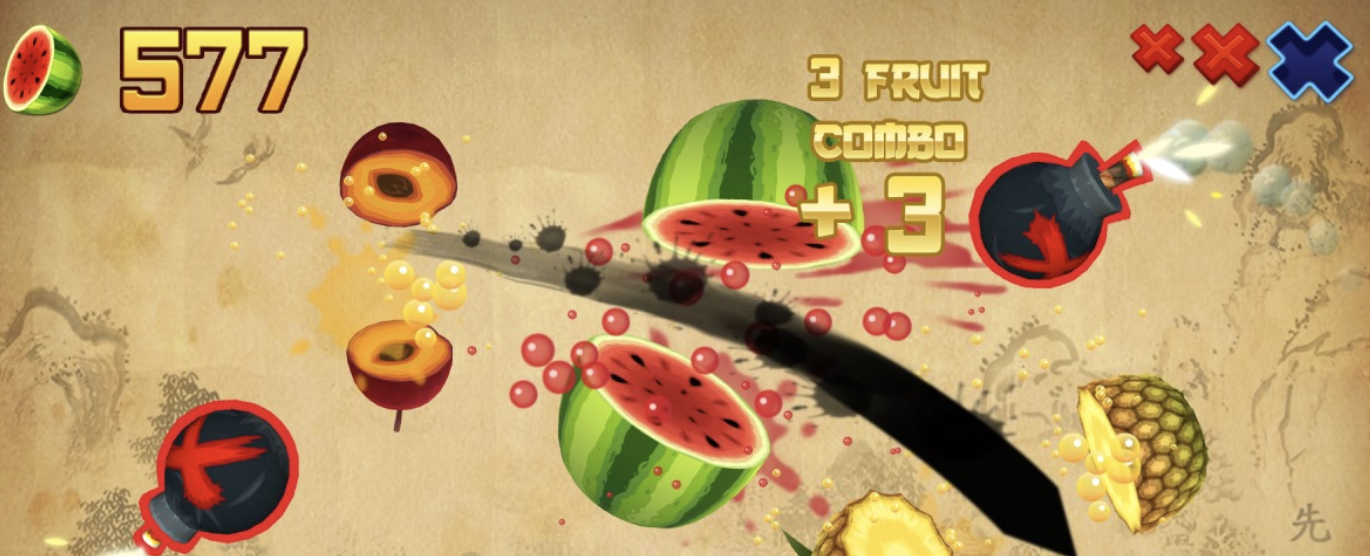
Designers call this "game feel," and the trick is that the response is always bigger than the input. The gesture is tiny, the simulated act is huge, and that gap is the whole product. You get the plausible consequence with none of the friction: no fatigue, no danger, no sticky counter, no cleanup. It's labor's cleanest reward, cut free from labor. Minimal work, maximum result.
And that's only the doing.
There's a whole second thread about watching other people work.
In 2013 Norway's public broadcaster aired twelve hours of a fire burning in national prime time, after an evening of chopping and stacking, and close to a fifth of the country tuned in. That broadcast became a landmark of "slow TV," and YouTube has since turned the impulse into an always-on genre: eleven million people follow one silent man building huts and kilns in the forest with his hands, others watch off-grid cabins rise from bare snow or a rusted tool come back to life, and millions more watch overgrown lots become geometric lawns.
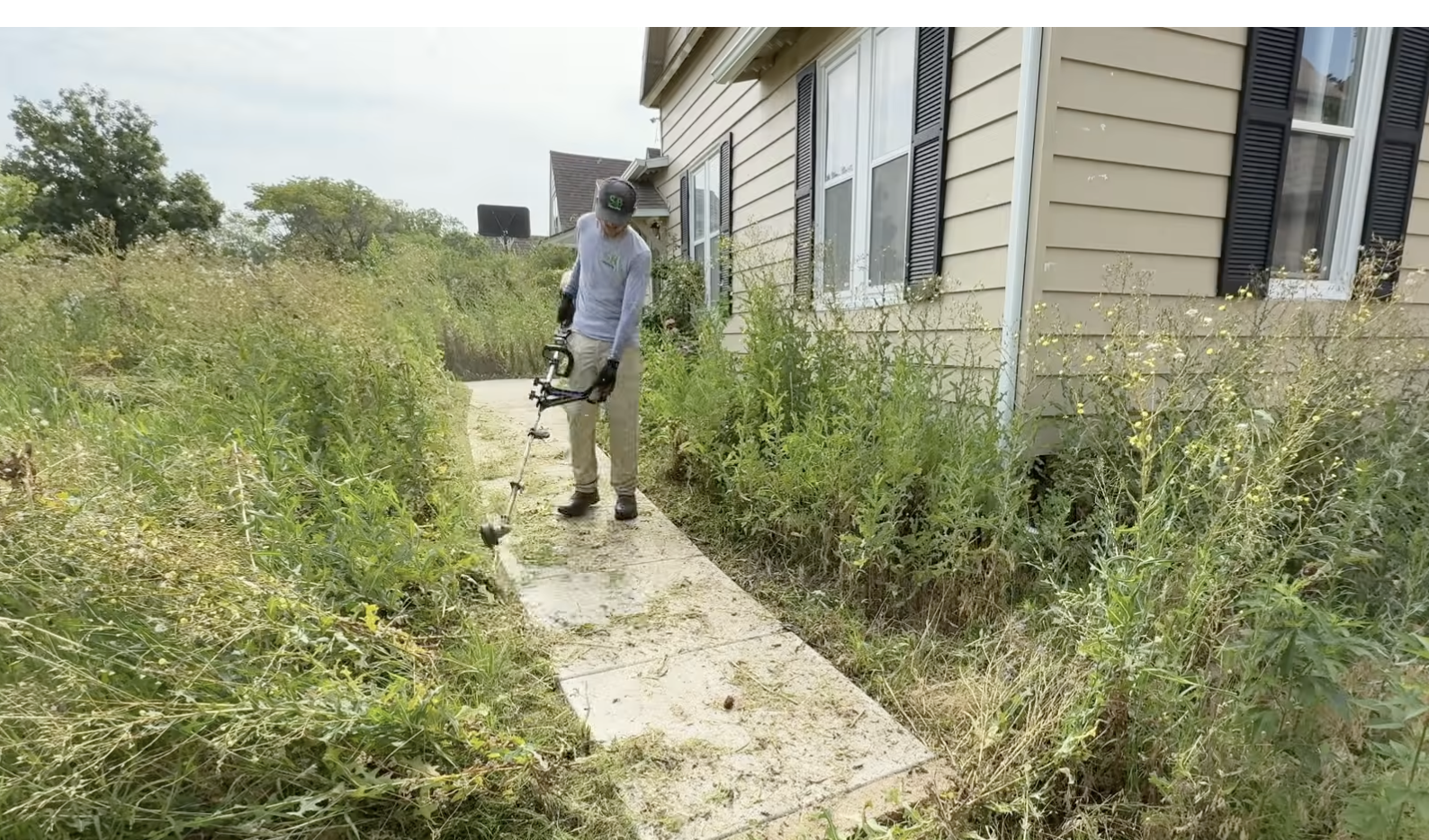
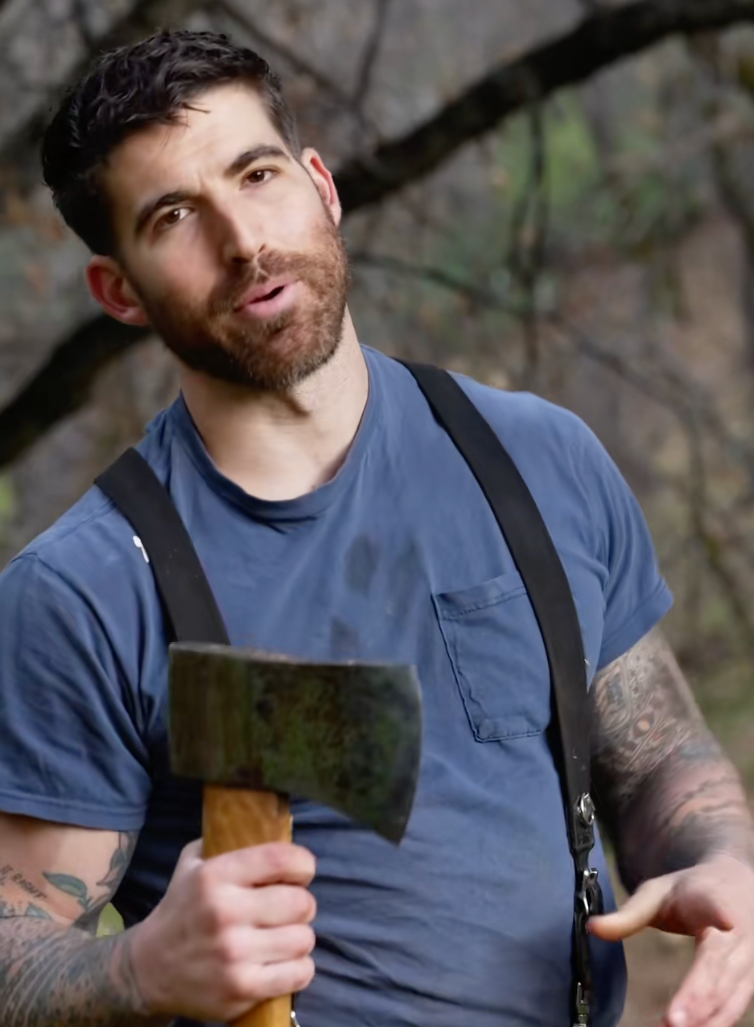
Some of it, let's be honest, isn't about the woodcraft at all: one of the internet's most-watched lumberjacks is named, I kid you not, Thor, and the comments under him splitting logs in slow motion have nothing to do with the best way to split logs.
Either way it's process, not instruction. Rust becomes shine, a jungle becomes a lawn, and the textured, repetitive sound of it calms the body the way ASMR does.
You get the rhythm and the before-and-after without standing up.
When a screen won't scratch that "itch," you can pay for the real thing by the hour. People hand over $485 to run a bulldozer around a Las Vegas lot for an afternoon, or several hundred dollars a day to mend fences and push cattle on a working ranch. The work a person might once have unionized to escape turns into a bucket-list afternoon the second you're the one who booked it. And paid for the pleasure.

So why does a person with a white-collar, clean, indoor job go home and pretend to chop wood or turn over cash to stand in pig muck?
David Graeber diagnosed the disease: a large share of us perform work we privately suspect is pointless while being paid to look busy. Matthew Crawford wrote the cure in reverse, arguing that manual work satisfies because the world answers back: the engine runs or it doesn't, and you never have to narrate your own usefulness because the object itself testifies. Teresa Amabile spent years inside people's workdays and found that the biggest daily lift to motivation is visible progress in meaningful work, the "small win." And the psychologists who study why games grip us keep landing on autonomy and competence: the pleasure of choosing a thing and getting visibly better at it.
Line those up, and the appeal stops looking like a joke. Simulated chores hand you the exact package abstract screen work refuses: a beginning and an end, a shrinking pile, plain cause and effect, no sprawling ambiguity, and the small clean voice that says, "I did that."
It's the same hunger cozy games now sell as mainstream mindfulness, the calm the whole category now markets itself on, and the same one wearing cute overalls, tasteful makeup, and brand deals in every cottagecore and homesteading feed.
Not all of it restores, though. Slow, textured, process-watching is one thing; the frictionless thumb-swipe through an infinite feed is another, and the second kind leaves people more bored, not less.
I want to resist the easy version of this, the one where the moral is "real labor is what we truly needed all along."
It isn't.
I'll grant that all of this is a first-world discussion. You are reading this email on a device made from materials mined in conditions incompatible with a joyful life. It and the infrastructure on which all of this runs are assembled by human fingers engaging in labor that you have, until just this moment, likely forgotten happens relentlessly in places around the globe. Some of that labor breaks brains as much as it breaks backs. You'll never watch any of this on TikTok.
Chosen effort and forced effort are not the same animal, which is why an hour on a Peloton feels like a reward and an hour of identical exertion on a job site feels like being used up.
And why an hour in a lithium mine is not something I'm going to spend my "hard earned" money on so I can cosplay real work in exchange for slave wages. Nor am I going to play games about the 3rd hourly-waged job a single parent has to take in the United States to pay for their most basic medical expenses.
Leisure exercise and occupational labor even diverge in their effects on the body.
Nobody's nostalgic for drudgery. What we miss is narrower and more specific: the phenomenology of consequential effort, which is friction, closure, a visible improvement, and stakes small enough to be safe... at least to us, as the end user. The screen took that texture out of our days, and now it sells it back as a toy.
If virtual chores keep handing me the closure my real days lack, do they heal the deficit or only numb it? I can't tell, and the honest answer is probably both. The research is strong on games as short-term stress relief and quiet on the thing I actually want to know: whether a fake finished pile feeds the same part of a person as a real one does, or just settles me enough to go back to the rectangle tomorrow.
A relief that makes the underlying lack easier to tolerate is not, by itself, a cure.
You can get the balm and the splinters from the same glass screen.
Signals Worth Tracking
The honest fake. I've spent a few of these letters nervous about the counterfeit pouring in: AI slop on every platform, synthetic output arriving faster than anyone can label it, the line between real and fake coming apart, and a new job called botsitting, where humans babysit the machines that are pretending to do the work. The firewood game is fake too, every pixel of it. And it may be the most honest thing on my screen, because it never claims to be anything else. It doesn't pretend I heated a house or logged a billable hour. This year Valve started requiring studios to disclose AI-generated content on Steam, a small institutional confession: this is simulated, and here's how. The chopping toy announces its own unreality. My inbox, filling with tidy, earnest messages I can't be sure a person touched, does not. Last week, I wrote that nobody can draw a bicycle from memory, that some shapes only live in your hands. This is the flip side of that coin. When the real gets hard to prove, the thing that admits it's a game might be the last screen you can trust.
When the machines do the chopping. Job Simulator meant its premise as a gag: the robots took the work, so play at it for laughs. Now it's aging into a forecast. As real physical labor gets automated out from under us, "work you can feel" may survive mostly as something you buy back in toy form. The firewood is already fake.
Watch for the day the axe is too.
In the meantime, I'm going to keep chopping virtual logs and broccoli.
/ David
Listening: "Timber", Pitbull ft. Kesha. Performed by two people who have never chopped down a tree in their lives. On theme.
Playing: Firewood. Four minutes, sound on. Don't overthink it.
Watching: Primitive Technology. One man, no narration, a hut rising out of mud and rock. It'll do more for your nervous system than this newsletter did.
Reading: Shop Class as Soulcraft, Matthew Crawford. The best case for why the engine that either runs or doesn't beats the email nobody ever reads.