Me at the Zoo
The first video on YouTube is 19 seconds of a guy noticing that elephants have long trunks. I have 141 hours of videos saved about how to make a video. One of these facts is embarrassing.
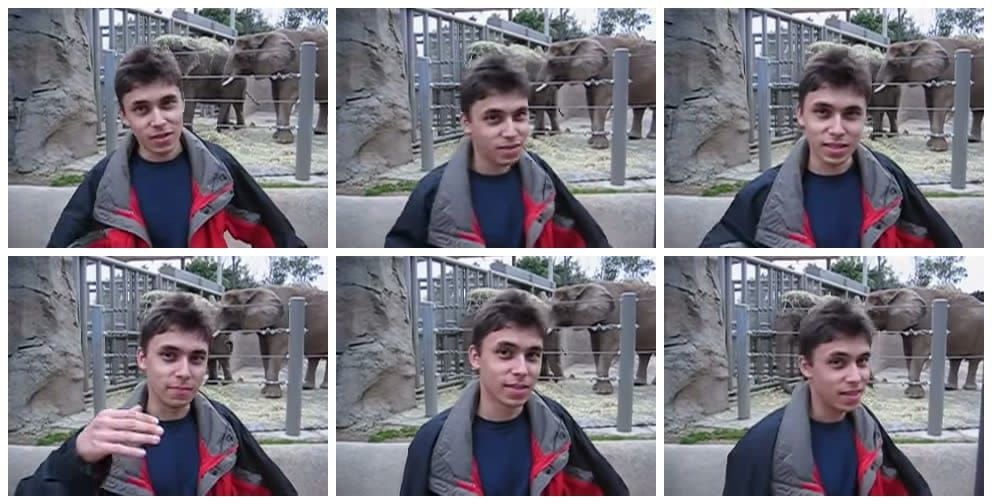
The first video anyone ever put on YouTube is 19 seconds long. Jawed Karim, one of the site's co-founders, stands in front of the elephant enclosure at the San Diego Zoo while a high school friend holds the camera. Posted on April 23, 2005, at 8:31 in the evening. Here is the entire script:
"Alright, so here we are in front of the, uh, elephants, and the cool thing about these guys is that, is that they have really, really, really long, um, trunks, and that's, that's cool. And that's pretty much all there is to say."
No "hey guys", no b-roll edits, no thumbnail with his mouth open in terrifyingly unnatural YouTube shock. It has been watched more than 433 million times, and in 2026 the Victoria and Albert Museum in London added it to its collection. It's now officially a design object, like a teapot.
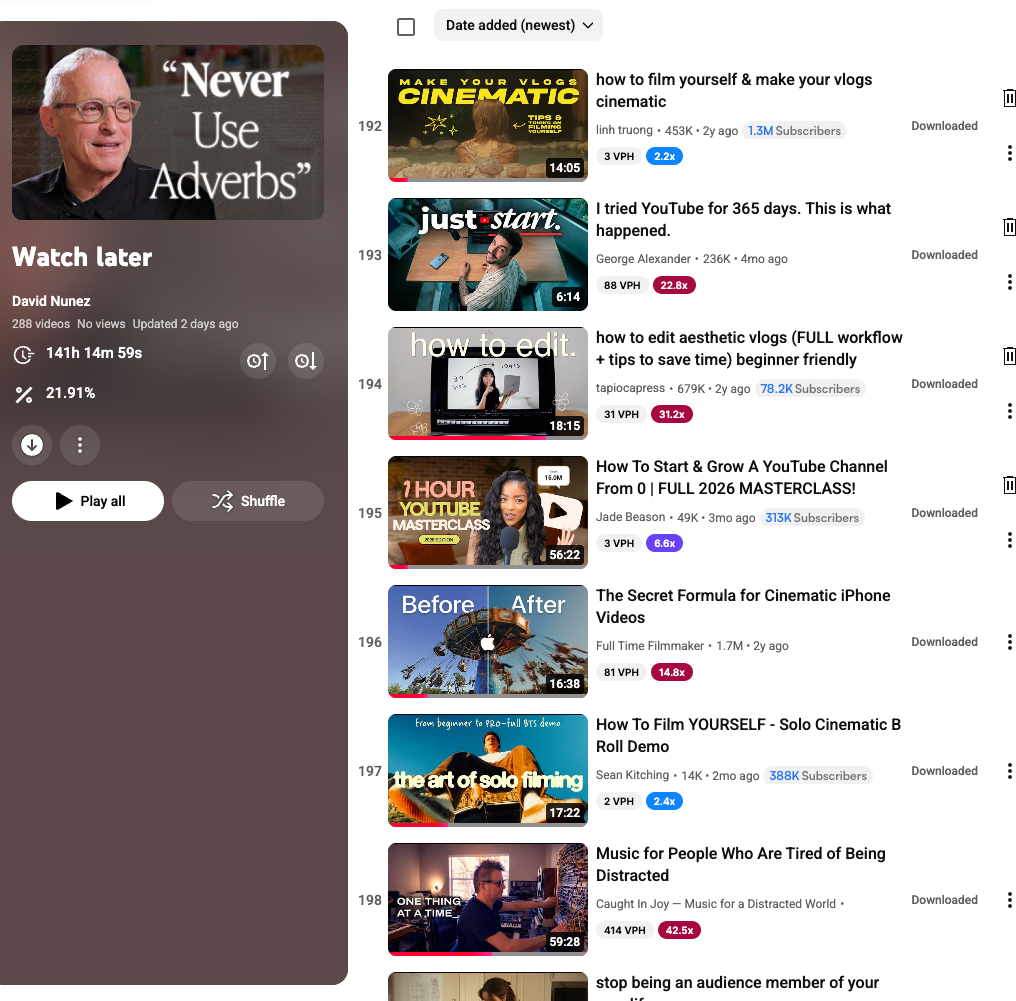
This week I exported my YouTube Watch Later list. It has about 280 videos in it, and they add up to 141 hours. By a rough count of the titles, about 170 of them are about how to make YouTube videos: how to light a room, how to write a hook, which settings to use in the camera app, how to get your first thousand subscribers. The longest is a six-hour "FULL COURSE" called "How to Get Famous in ANY Industry on YouTube in 2027." It's 2026. I'm apparently preparing for the future's future.
One of them is titled, in its entirety, "post one hundred youtube videos."
I saved it and have watched it 100 times. I have not, however, posted 100 YouTube videos.
Lately I've posted exactly zero.
Tsundoku is the pile of books you bought and haven't read, stacked up and left for later. In 2014 Christian Tietze named the digital version the collector's fallacy: knowing about a thing isn't knowing it, and bookmarking feels good because it makes the fear of losing the information go away. "To collect is a reward in itself," he wrote. The saving is the fun part. It's also too often the whole part.
In 2018 two researchers at the University of Chicago had people watch a five-second clip of the tablecloth trick, the one where you yank the cloth and the dishes stay put. Some watched it once and others watched it 20 times. The 20-times people felt far more ready. Across six experiments and 2,225 people, with darts, an online game and the moonwalk, watching over and over made people more confident, but not one bit better. The moonwalkers, per one write-up, were rated "pretty poor."
I have watched a lot of people moonwalk.
There was one thing that helped. In the last of the six experiments, people watched someone juggle bowling pins and came away feeling ready to graduate from clown college. Then some of them held the pins. The overconfidence deflated faster than a balloon animal. One feel of the real weight in your hand (or picking up 100 dropped pins) and your brain goes, oh, right, this is a thing I can't do.
@brad.byers88 Club Juggling Yes, I juggle too!!! tlThis is just a small sample of what do. bradbyers.com #juggle #juggler #juggles #clubs #bowlingpins
♬ Power Up - Super Sound
Yes, I know the ceramics-class story, the one where making fifty pots beats making one perfect one. I already told you it was a photography class. It still works on me.
Ira Glass gives the same advice with less clay: your taste is good before your work is, and the only way to close the gap is volume.
In other words, making more things leads to making better things.
Doing things poorly can also feel worse, which is why many of us avoid it. In 2019 Harvard physics researchers split students between polished lectures from star instructors and messy hands-on classes, same material, same handouts. The hands-on students learned more and felt like they'd learned less. The effort read as failure. Accumulating links in your Watch Later queue never feels like failure. It seems like progress since the number always goes up. That's the problem with it. Watching is safe. Making sends back error messages.
Everybody who's great at YouTube has a first video they'd rather you didn't watch. MrBeast's first uploads, at 13, under the name MrBeast6000, were Minecraft videos, and now he's reportedly worth $2.6 billion. One of Casey Neistat's early uploads, in 2010, explained when to pull the emergency brake on a New York subway car. You can see his signature style & taste peeking through the video, but the video itself isn't good.
So here's my plan. For the next hundred days I'm making things instead of saving them for later. Videos, yes, but also objects, software, small experiments, whatever the idea needs. Most of them will look like a guy in front of an elephant. That's the point.
More hours of "research" can wait. It's time to go hold the pin.
/ David
Watching: The Sultan's Elephant, a 46-ton wooden elephant that walked through London in 2006, and 100 elephants that stood on Comm Ave in Boston this summer.
Listening: Baby Elephant Walk, Henry Mancini, 1962. For the trunks.