Chains of Snowflakes
I started a hundred-day making streak. Then I spent two days researching whether streaks actually work. This went about as well as you'd expect.
So this email is about streaks, and about what happens when the counters we build to support the work start becoming the work.
I have owned a guide to finishing projects since 2023 and have never opened it.
GitHub's README Project has a piece by Aaron Francis called "Finish your projects." I saved it to my read-later app in 2023.
According to the app, I have since opened it zero times.
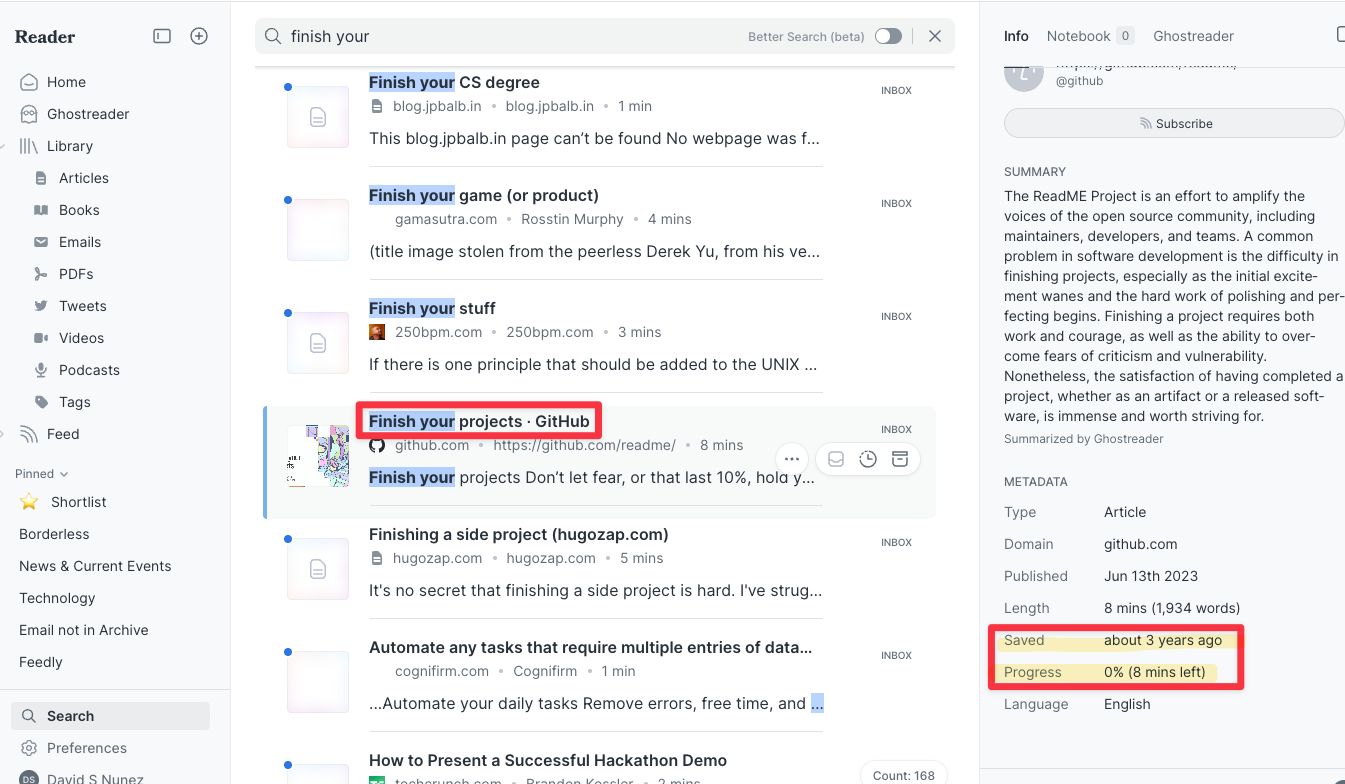
I finally read it this week, purely so I could tell you about it, which I am aware is not the same as taking its advice. It opens: "you're left with a graveyard of unfinished projects, wondering how anyone ever finishes anything. What does everyone else know that you don't?"
Rick Rubin's The Creative Act sits in my Kindle at 4% read. Somewhere in the other 96% is his warning about “demo-itis”: clinging to unfinished work for too long.
The Japanese have had a word for this for centuries: tsundoku, the art of accumulating books you haven't read. Apparently my graveyard of unfinished things has historical precedent.
Nassim Nicholas Taleb’s “antilibrary” turns the unread pile inside out. Umberto Eco’s 32,000+ books weren't a backlog awaiting "finishing." The unread ones represented everything he might still learn.
Which creates an inconvenient distinction for me: not everything unfinished is a failure. Some unfinished things are possibility. Others are abandoned promises to yourself.
Or, less generously: finished books are dusty monuments an overconfident reader erects against the nagging reminder of how much he doesn't know.
You don't Inbox Zero an antilibrary.
Which brings me, inevitably, to the man who invented Inbox Zero and couldn't finish his book about productivity.
Merlin Mann invented Inbox Zero, signed a contract to write the book, and never finished it. He told Oliver Burkeman that "this topic of productivity induces the worst kind of procrastination," and he was spending mornings away from his three-year-old daughter to type material for his editor about how to use time well.
This is the classic tension between the crazy-making Dilettante and the inflexibly Focused... exploration versus exploitation, generalist versus specialist. One starts everything. The other finishes things that maybe weren't worth starting.
The Explorer says: “Ooh, what else could I make?” The Exploiter says: “Just finish what’s in front of you.”
There’s a tradeoff. A recent analysis of 49 million publications found that generalists sustained innovative work longer than specialists. The catch: they published less.
I don't want to stop starting things. I want to get better at finishing the ones worth finishing. The unfinished pile can stay. I just want more things to escape from it.
That's also the idea behind John Roberts's “Luck Surface Area." Do interesting things, put them into the world, and give luck more chances to find you.
Darius Kazemi makes the same argument in his XOXO talk. You don't know which little thing will hit, so make lots of little things and put them into the world. Each one is another lottery ticket.
Luck favors the person who keeps leaving things lying around for it to trip over.
Make things. Share them. Give luck a bigger target.
Don't break the chain

So the way to make more things is obviously to build a system for making more things, right? Right?
The "Don't Break the Chain" method traces to one blog post from 2007 recounting a single remembered conversation, and when it reached Jerry Seinfeld he called it "the dumbest non-idea that was not mine, but somehow I'm getting credit for it."
The idea behind the system is insultingly simple: pick one thing you’re supposed to do every day, do it, and put an X on a calendar. Do it again tomorrow. Eventually you have a satisfying little row of Xs, and your brain, apparently more concerned with preserving a line of stationery than with the fact that every X represents another day closer to death, becomes unwilling to break it.
That’s basically it. The chain gets long enough that maintaining the chain becomes its own motivation. Which is both the point and, maybe, the problem. If you miss a day, civilization survives. You start another chain and try to make that one longer.
James Clear built his entire brand on the neighboring idea that small actions compound over time. Improve 1% every day for a year and, mathematically, you end up roughly 38 times better.
“Better” is an open question.
The logic is seductive. More days means more things. More things means more lottery tickets. Keep the chain compounding long enough and eventually something good should happen.
I guess 🤷🏻?
Streaks in the Wild
- In 2011, César Kuriyama turned 30, quit his advertising job, and gave himself a beautifully tiny assignment: record one second of video every day. The plan was to stitch those 365 seconds into a six-minute memory of the year.
Choosing a second worth remembering started changing how he spent the other 86,399 seconds. The act of documenting his life was subtly shaping it.
At the end of the year, he stitched the clips together into 1 Second Everyday – Age 30. It went viral. Eventually the experiment became an app used by millions. Here's the TED talk. The counter, in other words, was doing something. - Sometimes the constraint is the whole system. NaNoWriMo started in July 1999 with twenty-one people in the Bay Area. Chris Baty moved it to November the next year “to more fully take advantage of the miserable weather.” Of 140 people who signed up that year, twenty-one finished. Morning Pages asks for three handwritten pages every morning about whatever falls out of your head. Inktober started as a daily drawing practice in 2009. The prompt list most people now associate with it didn't arrive until seven years later. And Advent of Code publishes a programming puzzle every day in December: in 2024, roughly 290,000 people finished Day One and about 27,000 made it through Day Twenty-Five. (In this case, I think attrition is related to developer interview hazing.) Words, pages, drawings, code. Pick a unit, pick a clock, start counting.
- Tim Ferriss, in an almost too-perfect demonstration of being Tim Ferriss, adopted Morning Pages to improve his productivity without bothering to read the book it came from.
- Karl Baden has photographed his own face every day since February 23, 1987, the day after Andy Warhol died. In thirty-nine years he has missed exactly one: October 15, 1991. He was driving to Providence to teach, meant to take it when he got home, and forgot. His assessment was simply, “that was that.” Then he took another photograph the next day. Tehching Hsieh took this further. For his Time Clock Piece in 1980–81, he punched a time clock every hour, on the hour, for a year. Of 8,760 possible punches, he missed 133. Ninety-four because he was asleep. Twenty-nine because he was late. I don't know if he was paid overtime. Hsieh published the misses. Failure wasn't outside the finished work. It was part of the record. Baden missed a day and kept going. Hsieh missed 133 hours and made the misses part of the work. The chain broke, but the practice didn't.

- A hundred days can mean very different things. In 2005, Michael Bierut (who designed the MIT Museum identity while I was there) assigned his Yale graphic design students to choose one operation and repeat it every day for 100 days. The results were unforgiving: “Up to two dozen students start the assignment. And some years, more than half drop out before the end.” Bierut noticed that things got repetitive around day ten, but students who survived to day thirty or forty tended to find a groove. Independently, the #100DayProject landed on the same suspiciously round number with almost the opposite attitude toward failure. Its current FAQ says, “Most people miss a day (or a lot of days). Sometimes people take a year or two to finish their project. However many days it takes you to do your project is perfect.” Over a hundred days, Bierut's version has dropouts. #The100DayProject has people who haven't finished yet.
There are apparently a lot of ways to count.
A Japanese lord spent twenty years looking at snow through a microscope.
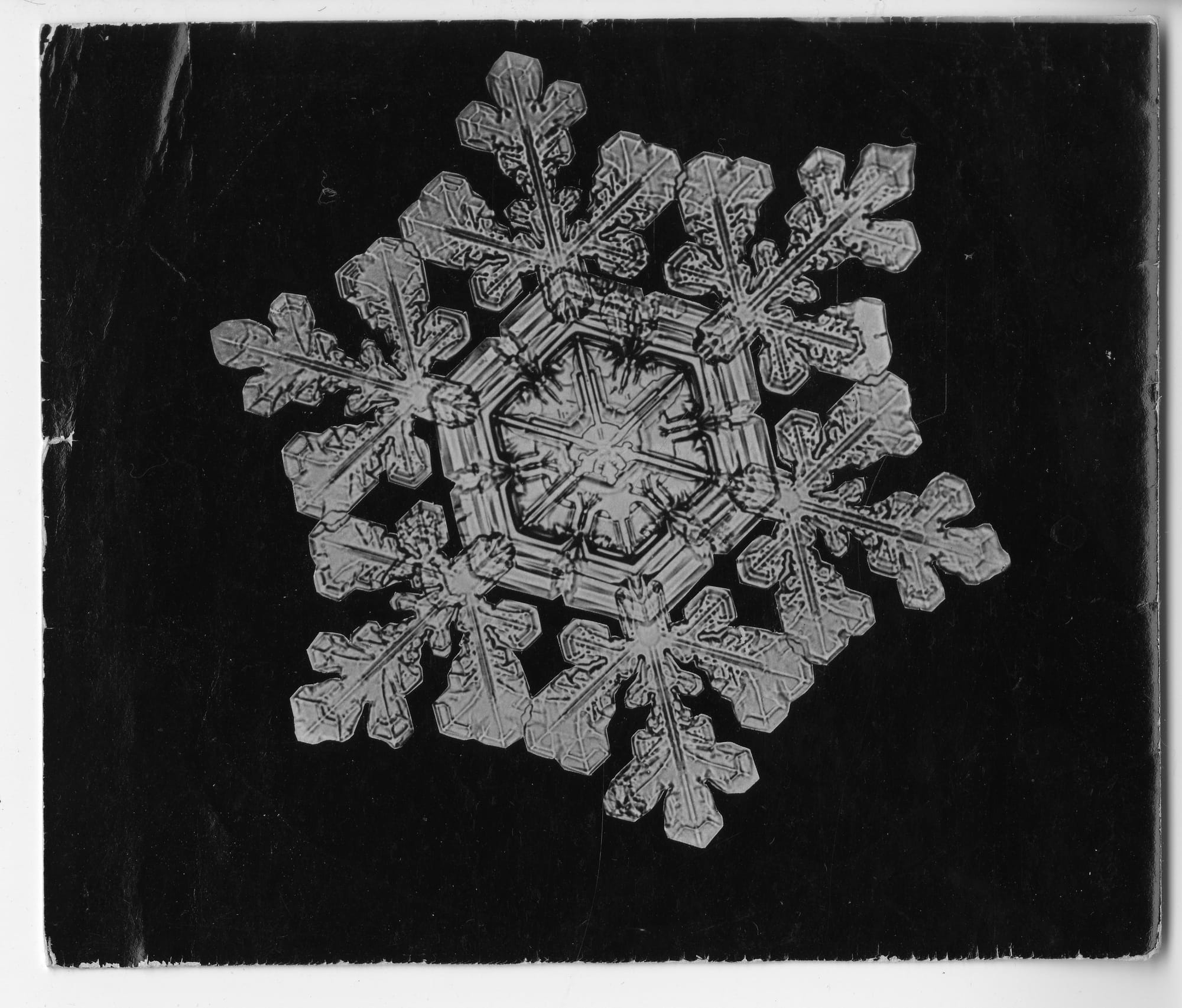
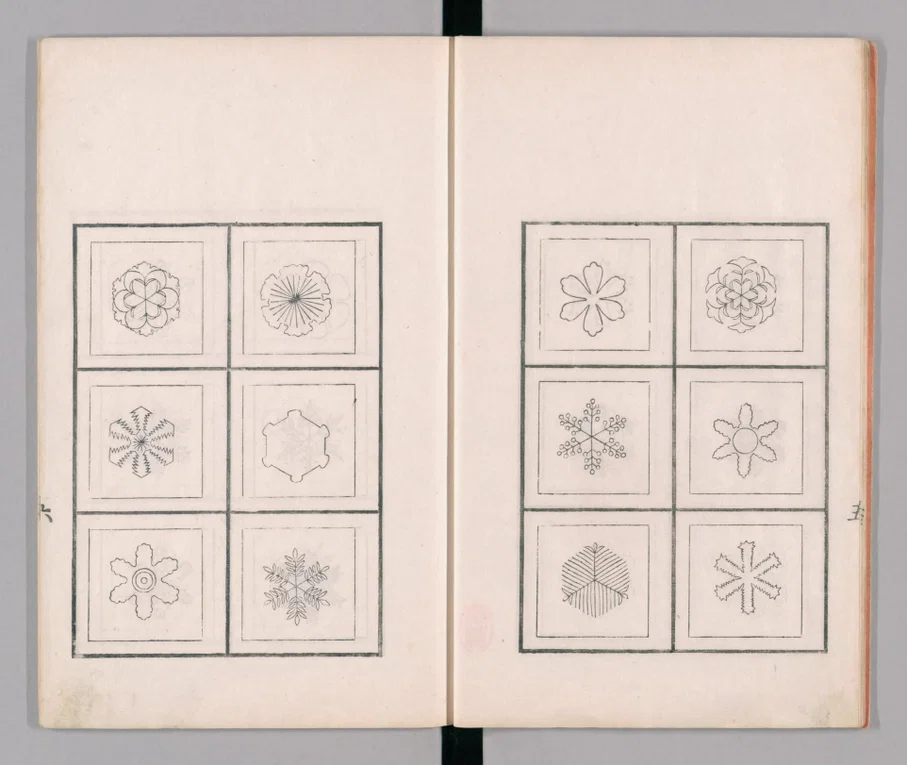
Two people, one flake, no idea about each other (via Public Domain Review and Smithsonian Institution Archives)
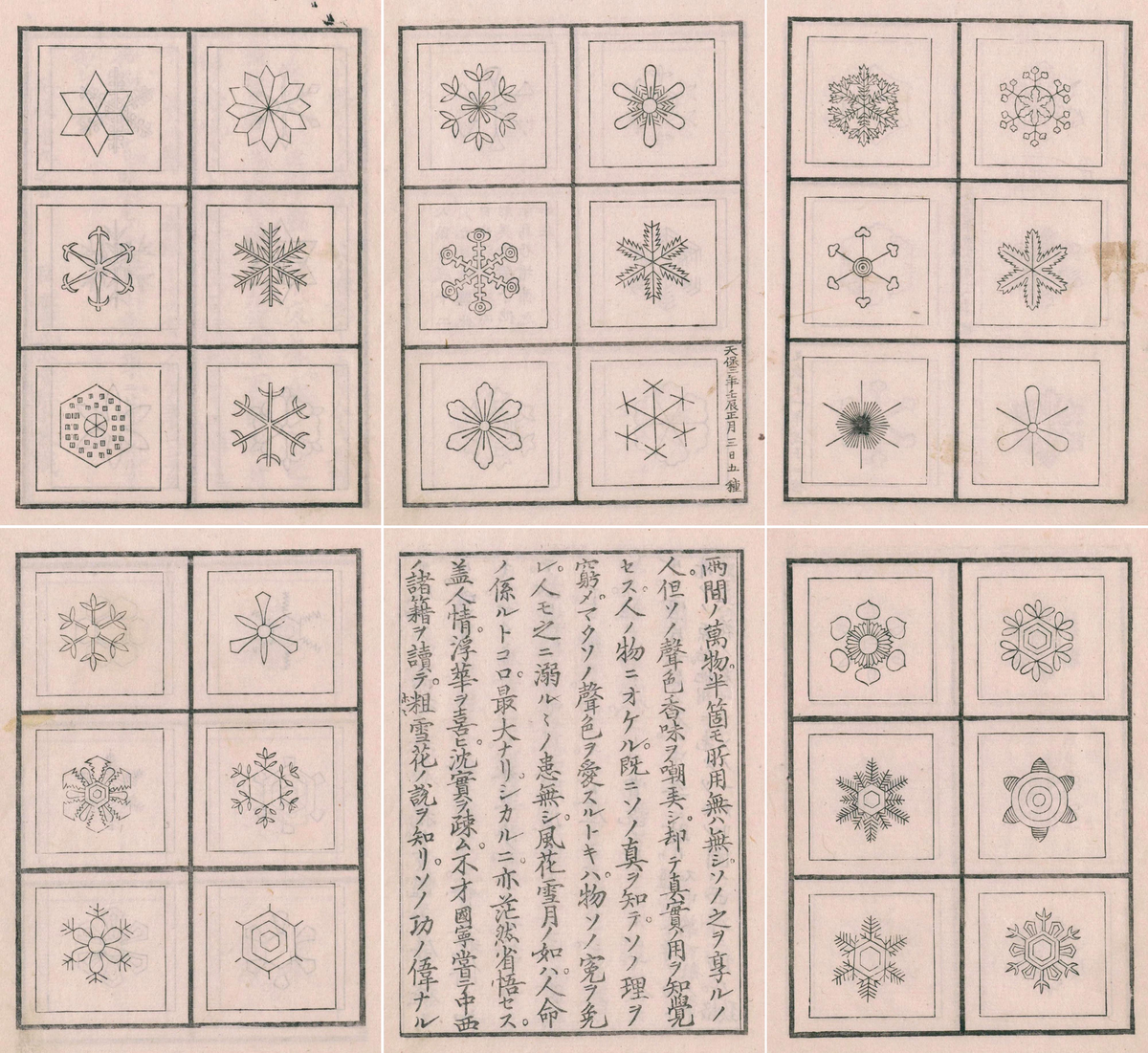
Doi Toshitsura ruled the Koga Domain in the early nineteenth century and was likely the first person in Japan to examine ice crystals under magnification, using a Dutch microscope imported through Dejima, the country's only port open to Western traders.
He put a black cloth outside ahead of time to pre-cool in the winter air. Otherwise the snow would melt on contact. He caught fresh snow on it. Then he moved the flakes with tweezers onto a lacquerware tray, one at a time, careful not to breathe toward them, and looked.
And then he did it again.
He kept doing this for twenty years. The surviving account gives us no chain of days, only the flakes. In 1832 he published eighty-six of his observations as Sekka Zusetsu. He printed it privately, in small runs, and gave it away. People started calling him the Snow Lord.
Eventually the observations escaped the microscope. Snowflake patterns derived from his drawings appeared on textiles, ceramics and other objects around Edo. He had spent two decades looking closely at something that melted almost immediately. Somehow the looking lasted.
Half a century later and half a world away, nineteen-year-old Vermont farmer Wilson Bentley pointed a camera through a microscope and finally got one.
Bentley kept at it for forty-six years, eventually photographing more than 5,000 snow crystals on four-inch glass plates, using essentially the same rig he'd built as a teenager.
His reason was simple: once a snowflake melted, its design disappeared without leaving a record. “Just that much beauty was gone.”
He worried about the records disappearing, too. In 1903 he sent five hundred photographs to the Smithsonian, grateful to have them placed “beyond all possibility of loss and destruction, through fire or accident.”
Near the end of his life, the American Meteorological Society helped turn his archive into a book. Snow Crystals, published in 1931 with text by William J. Humphreys, contained more than 2,400 of Bentley's images.
Bentley died of pneumonia that December.
Toshitsura left eighty-six drawings. Bentley left more than five thousand photographs. Neither story starts with the number. The numbers came afterward. First they kept looking.
The greatest invention.
I've watched the documentary The Invention of Dr. Nakamats more times than is probably necessary, so I already knew where to find someone who had taken self-documentation considerably further.
Japanese inventor Yoshiro Nakamatsu, better known as Dr. NakaMats, claims thousands of patents and inventions, including the floppy disk, the CD, the digital watch, and the self-defense wig. Many of these claims are, to put it generously, "disputed."
But in 2005 he won an Ig Nobel Prize for something considerably better documented: photographing every meal he ate for thirty-four years.
Every meal. Every day. For decades. NakaMats turned himself into a longitudinal study with a sample size of one. He was trying to work out which foods produced his best inventions, which is either a rigorous approach to dinner planning or a very long way to avoid cooking something new. He eventually developed theories about nutrition, brain function and longevity, and announced plans to live to 144.
Toshitsura and Bentley spent decades pointing their instruments outward. NakaMats pointed his inward.
Breaking the chain.
Streaks can eat the thing they were built to protect.
I'm concerned about this turn from productive streaking to something... else. Compulsion? Superstition? Accounting fraud against yourself? Narcissism? Hubris?
So I went looking for validation that streaks are, on balance, a good idea.
I did not find much. And once I started tugging on that thread, a surprising amount of the received wisdom about “doing the work” came apart with it.
- Strava incentivizes people to maintain streaks through digital badges and even sponsor rewards. Researchers who interviewed fitness streakers found people running through injuries or shrinking runs to preserve the number. One participant: “I'm gonna keep streaking, I just gonna cut my mileage, just run a mile, just to get my streak.” At some point, each mile transforms from exercise in the sun to a row in a spreadsheet.
- Duolingo's research portal lists twenty-two papers and the word "streak" does not appear on it. They publish on spaced repetition and notification algorithms, not on their most famous mechanic. Their own blog says the streak works by tapping "loss aversion," while a leading study of broken streaks never mentions loss aversion and found that negative emotion did not mediate the effect in either of its two experiments. The mechanic is famous. Why it works is considerably less settled.
- Morning Pages have no indexed study in PubMed or Europe PMC. The research commonly cited in support of them is James Pennebaker's expressive writing, which was four consecutive evenings, fifteen minutes at a time, writing about a specific trauma, with health-center visits tracked afterward. Julia Cameron's practice is open-ended, in the morning, three pages, about nothing in particular, and measured against a vague feeling of getting unblocked.
- The ceramics-class parable, where the group graded on quantity supposedly produced better pots, wasn't a study and wasn't ceramics. It traces to photographer Jerry Uelsmann, who used the exercise with his photography students. Ted Orland later said he deliberately changed photography to ceramics when retelling it in Art & Fear. A classroom exercise became an experiment in the retelling, but there was no control group, no measurement, and no publication. Just fodder for LinkedIn thought leaders.
- The ten-thousand-hours idea Malcolm Gladwell popularized in Outliers drew heavily on a 1993 study of violinists that did not replicate cleanly in 2019. The best violinists had accumulated no more solo practice hours than the good ones. Anders Ericsson spent years objecting that Gladwell had mangled his work and that there was "no evidence for a magical number." (Though Josh Kaufman thinks it's twenty hours).
- The twenty-one-days-to-form-a-habit rule traces to a plastic surgeon who noticed in 1960 that patients took about three weeks to adjust to their new faces. He generalized from there: “a minimum of about 21 days” for an old mental image to change.
- And physician Kyra Bobinet attributes broken-streak responses to the habenula, a small brain structure involved in processing outcomes that are worse than expected. Her behavioral advice may be sound. The neurological explanation is much more speculative. The habenula research she draws on is largely monkeys and rodents in conditioning tasks, and I couldn't find direct human evidence connecting the mechanism specifically to habit streaks. The peer-reviewed paper underlying the book hedges in its own abstract: a “theoretical approach,” its “promise” as “potentially more effective,” closing on “avenues for future research.” The book jacket says you can “neutralize failure and unleash your inner wisdom and strength.”
Even the platitudes are borrowed.
- "The only rule is work" is Corita Kent, rule seven of the Immaculate Heart College Art Department Rules. It gets credited to John Cage because he wrote rule ten, and Stewart Brand later ran the list in the Whole Earth Catalog.
- The line about having a hundred thousand bad drawings in you was said to Chuck Jones by a Chouinard instructor whose name he never recorded, and is now attributed to Walt Stanchfield about as often.
- The Picasso one about inspiration finding you working (“La inspiración existe, pero tiene que encontrarte trabajando”) doesn't appear in print until after his death. Its earliest known appearance is a 1994 book about urban social movements in Latin America, twenty-one years later.
I spent two days researching how to do the work. The research says I should probably stop researching and do the work.
Rude.
Building the links.
Still, the counter isn't useless.
Alcoholics Anonymous members have understood the power of the counter for decades. It makes an invisible accumulation of days physical. One day becomes a chip. Then 30. Then 90. The number is arbitrary. What the number comes to represent isn't.
There is good evidence for making progress visible. A meta-analysis of 138 studies and nearly twenty thousand people found that monitoring progress improved goal attainment, especially when the record was made public or physically recorded.
It feels bad to break a streak. Seventeen runners who broke streaks of a hundred days or more described what researchers called a grieving process. Some used the word themselves. And then they went running again. Every runner physically capable of doing so eventually returned to regular running. “No long-term negative consequences were reported.”
I assumed the longer the streak, the harder the fall. I couldn't find evidence for it. The nearest experiments found no difference between breaking a three-day streak and a six-day one, or a four-day streak and a twenty-day one.
I may have been giving the counter too much credit.
Octavia Butler wrote, “First forget inspiration. Habit is more dependable.”
Hrm. I suppose let's find out.
I am on day two of a hundred. It took three tries just this week to get there.
Toshitsura spent twenty years with his tweezers and cold cloth, looking at snowflakes that melted while he looked.
Tomorrow, I suppose, is day three.
/ David
Quoting:
... after everything else has worn off, there remains the deep and quiet joy of having accomplished something. Maybe it was a great success, maybe it wasn't. That part is out of your control. What’s in your control is seeing it all the way through, and you did that. - Aaron Francis
Listening: "Finish What Ya Started," Van Halen, 1988. A song about not finishing something, by a band that finished it in about four minutes.