But Can It Run Doom?
Someone built a working screen out of rubber and vacuum, and its brain is also air. A short tour of computers with no electronics in them, including one made of pink water that flooded the London School of Economics.

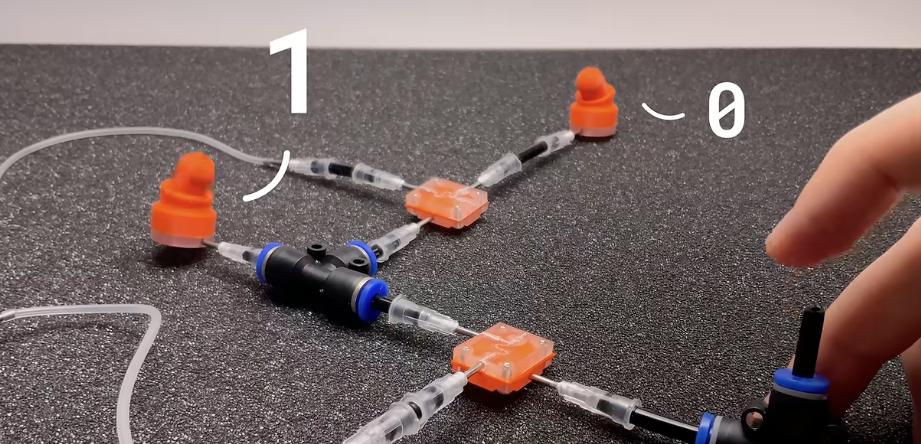
A YouTuber built a screen with no lights in it. It's a sheet of orange rubber stretched over 64 little pockets. Suck the air out of a cavity and the rubber above it dents inward, and the dents' shadows make the picture.
Computers run on ones and zeros, and normally those are electricity pulses, on or off. His uses suction. Sucking is a one and not sucking is a zero. Indeed.
He 3D-prints tiny valves that do the job transistors do inside a chip, connects them with little tunnels where you'd expect wires, and lets the air sort out the rest. (A pump and a few electric valves still run the show from the back.)
Then, as one does, he plugged in a game controller and played Pong, which he says is "really pushing the speed limit of the display." Snake, he reports, is "surprisingly playable."
I gravitate toward videos like this one. One person obsessed with making something weird at a workbench, passionately describing nuanced decisions, including what went wrong: the printed parts that warped, the store-bought rubber that wouldn't seal, the handful of dots that, in his words, "refused." I'd rather watch that than some highly polished product design demo video.
I'm planning to make more of this kind of thing myself this season, so stay tuned.
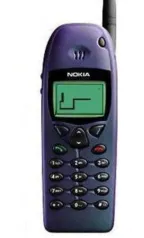
Snake, the video game, is a spiritually strong test for a new kind of screen. Snake started as Blockade, a 1976 arcade game that took 3,000 orders at a single trade show, and it reached most of the planet in 1997 because a Nokia engineer named Taneli Armanto put it on a phone. The Museum of Modern Art has it in the collection.
A more demanding crowd asks whether a thing can run Doom, the 1993 id Software shooter that, if I'm being honest, I spent way too much time playing when I should have been having a normal teenage life. This obsession with making Doom run on inappropriate hardware has gotten out of hand. It has run on a Canon printer, a John Deere tractor, a Lego brick, and, officially, a Husqvarna robot lawnmower that fires when you press the knob. It has run inside Doom. It has run as a CAPTCHA that makes you kill three enemies to prove you're human. It has run on a calculator powered by 100 pounds of rotting potatoes. In 2020 someone ran it on a pregnancy test, then clarified that both the screen and the chip were replacements, so the pregnancy test was contributing a plastic shell.
In 2024 an MIT grad student worked out how to run it on E. coli, in simulation, with each glowing bacterium as one dot. A single frame takes 70 minutes. Finishing the game would take about 600 years, so bring a sandwich, or at least a bottomless bowl of Cheetos.
Computers made of air are older than YouTube. In the Cold War it was a whole field, and the first working parts, in 1959, were built out of soap, linoleum and wood.
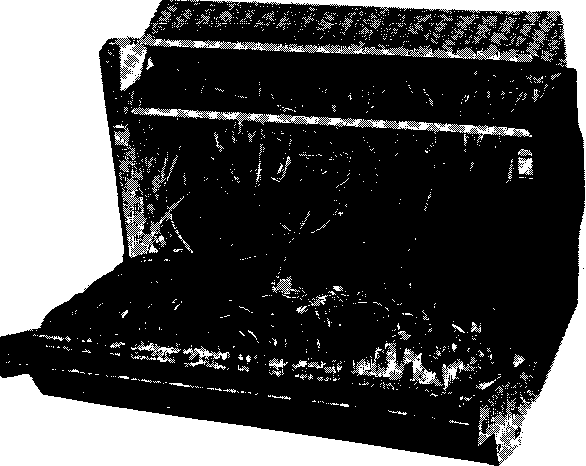
In 1964 Univac went the whole way and built FLODAC, a working computer with no electronics inside. About 250 little jets of air did its thinking. To flip a switch you rested a finger over a hole. To read the answer you looked at a row of glass tubes, each with a colored ball in it, and a ball floated up when the answer was a one. Its status light was a marble. The engineers wrote, with what reads as relief, that it "was operating reliably only a few weeks after construction was begun."
I've never said that about anything.
A flute runs on the same trick. Cover a hole and you change the length of the air column inside, and the note moves. The fingering chart is a program, and your fingers are the valves. Player pianos automated the fingers. A roll of punched paper slides over a row of little holes, and wherever the paper has a hole, suction presses the key. Sheet music, read by air.
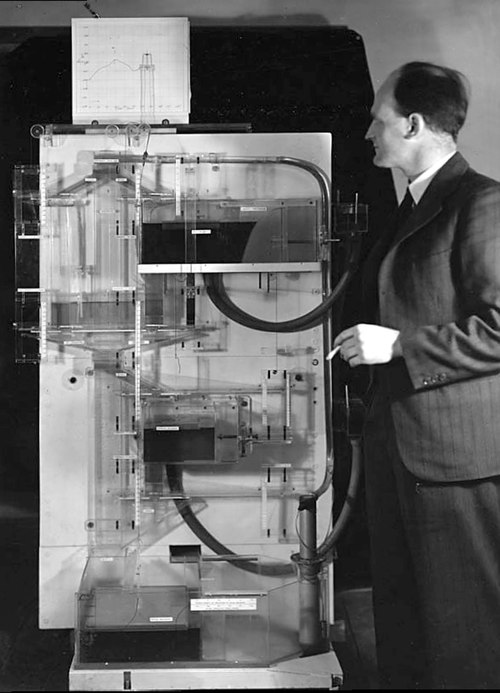
In 1949 a student at the London School of Economics named Bill Phillips built a working model of the British economy out of water, in his landlord's garage.
Pink water played the part of money. The clear plastic tanks were cut from the windshields of old Lancaster bombers, and the motor came off a plane's windshield wiper. It turned out to be accurate to about 2 percent, which is better than a lot of economists manage without getting wet.
It also leaked. Phillips had drilled a hole that squirted water whenever there was inflation, and his colleagues kept coming back to find the room "a pool," which they mopped up with towels borrowed from the cafeteria. A Science Museum curator later described "an incontinent machine which had disgraced itself during a class."
A messy, leaking machinery of pipes has to be a metaphor for the economy on some poetic level. Probably involving drowning in debt or something like that.

Air computers lost to the microchip, though a piece of one is still on your car. The nozzle that fans washer fluid across your windshield is a leftover from that era, and it's now the standard way to clean the cameras on self-driving cars.
In 2021 a lab at UC Riverside built a memory chip that runs on air and used it to make a pair of rubber hands play "Mary Had a Little Lamb" on a piano.
The press release brings up Baymax, the inflatable robot Disney made us cry over.
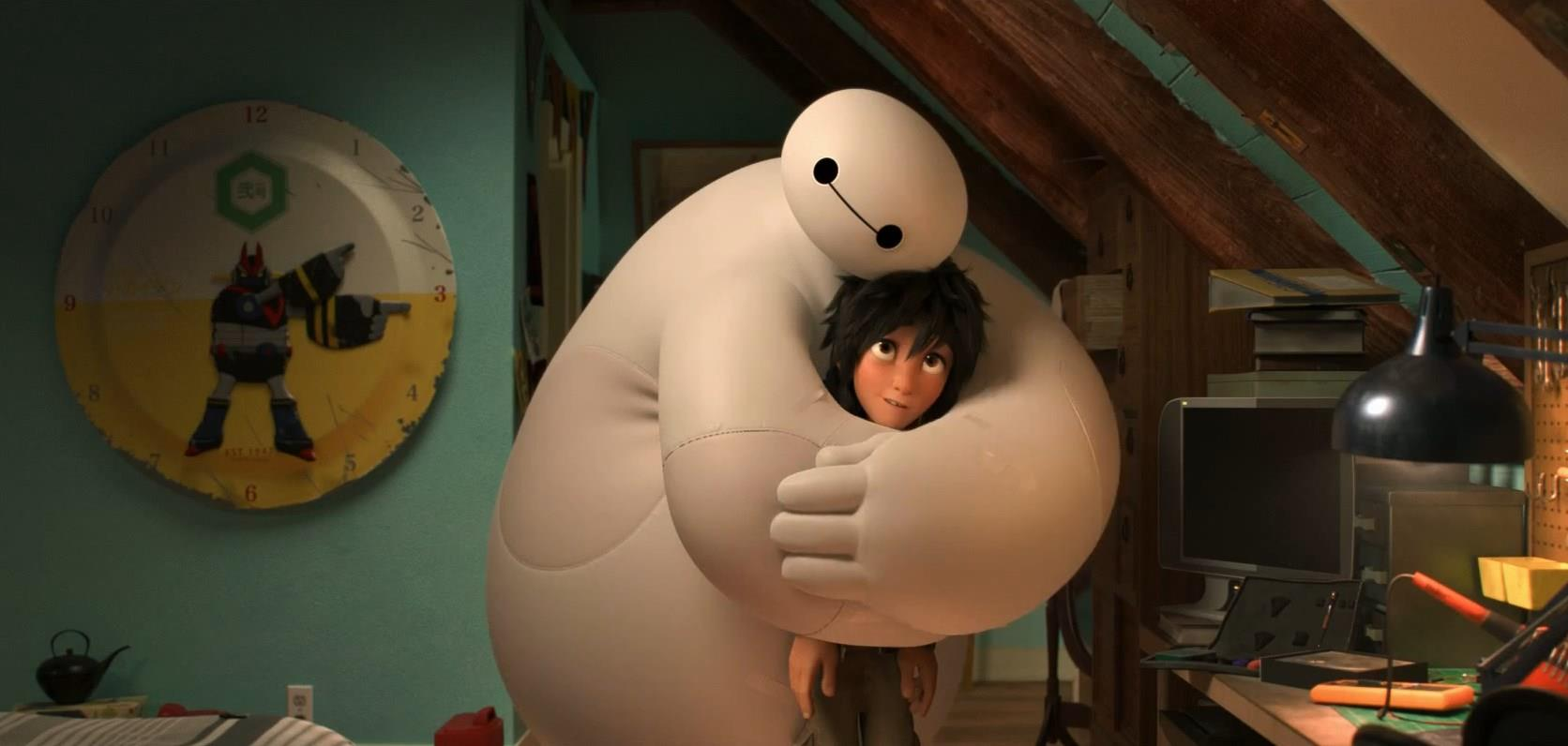
And in 2012 a team in Kobe built computer parts out of live crabs. They steered the swarm through little mazes by casting a shadow shaped like a hungry bird. One of their two circuits worked, and the other, per MIT Technology Review, "was much less reliable," which I find relatable.


The top comment under the air bubble display YouTube video reads: "this could be a way to display braille if it could get small enough." It's a good idea, because braille screens for blind readers cost thousands of dollars. Every raised dot needs its own tiny motor.
A group at Cornell is trying to replace the motors with very small explosions. "Instead of having 1,000 moving parts, we just have a few parts," one of them said. Or maybe a few blown up grad student fingers?
A rubber sheet and a vacuum pump sounds like the calmer way to get there.
The YouTube creator has an early video on his channel called "I Built a Soft Robotic Snake." He got from there to playing Snake on a sheet of rubber.
He ends this one by pointing out that each dent also works as a tiny suction cup, which means, in his words, "this display is actually a robot."
Doom is presumably next. I can wait… for the frame to render.
/ David
Listening: "Breathe", The Prodigy, 1996. "Breathe the pressure, come play my game."
Watching: Air Powered Display: 3D Printed Fluidic Multiplexing